Overview
Portugal sits at the westernmost edge of the Eurasian continent. My geographical intuition is poor, whenever I choose travel destinations on a map, I subconsciously overlook this country. It wasn’t until I had been in Europe for many years that I finally thought to make a special trip here.
Upon getting off the plane, the damp, salty, lukewarm air rushed in, soaking my nasal cavity. Thick, sturdy clouds floated above the wide airport, exerting a strong visual pressure. I am used to traveling within inland Europe, so I rarely see such a massive contrast. The greater the contrast, and the more bizarre the experience, the richer the flavor of the journey becomes.

At Lisbon Airport
Because of its proximity to the sea, the entire city is often shrouded in sea fog in the early morning. Even as the sky gradually brightens, the undulating streets remain mysterious and trance-like. The streetlights are dim and yellow, lowering their eyes and exuding the weariness of dawn, as if humming something in a low voice, guiding lost souls into a labyrinth with no known end.
As the sea fog disperses, the sun reveals its true form. Even in the harsh winter, its gentle rays shine upon the earth, and my body actually warms up. The temperature in Lisbon is not low—hovering between 10 and 16 degrees Celsius in winter—though the nights are cooler, requiring just one extra layer of clothing to cope.
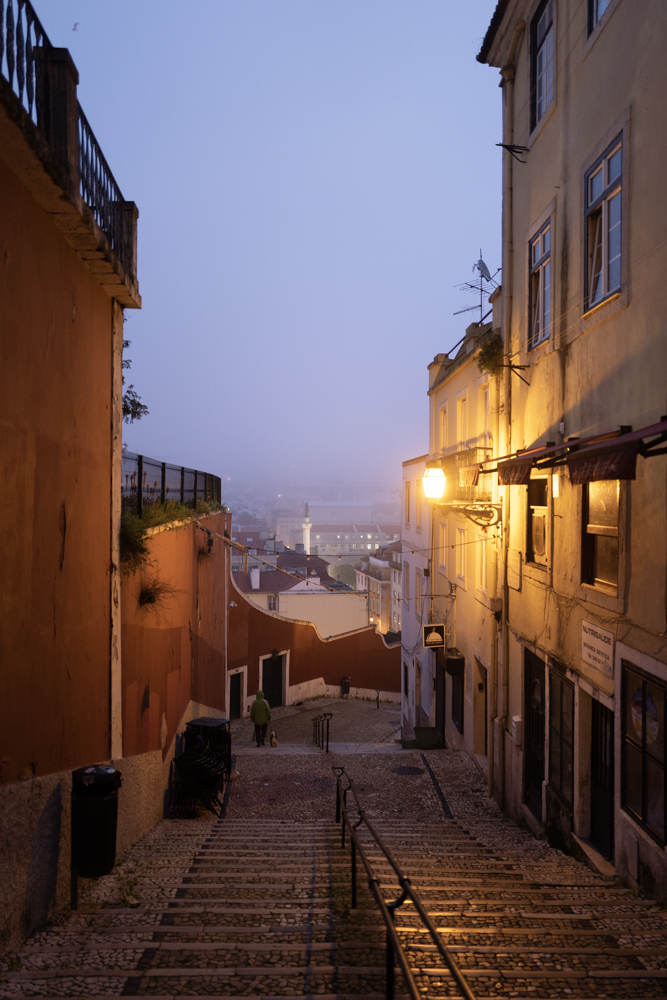
Lisbon in the early morning
Barcelona, another coastal city, gave me more sun and sea, full of golden energy. Although Lisbon is also close to the sea, what it incubates more is the ocean’s coarseness and recklessness.
Looking down at Lisbon from the air, its streets are twisting and winding. The meandering paths are like capillaries, climbing rhythmically all over the city following the rise and fall of the terrain. The buildings on both sides of the roads are thin and tall. Although their textures and appearances vary widely, they are packed tightly at the joints without the slightest gap. The twisting roads force the buildings to arrange themselves in a snake-like formation. Due to the winding nature of the roads, nearby walls often obscure the scenery behind them. Buildings and walls play hide-and-seek, being amongst them constantly stimulates my nerves for exploration. But this is merely horizontal concealment—what pushes this thrill to the extreme is the vertical dimension.
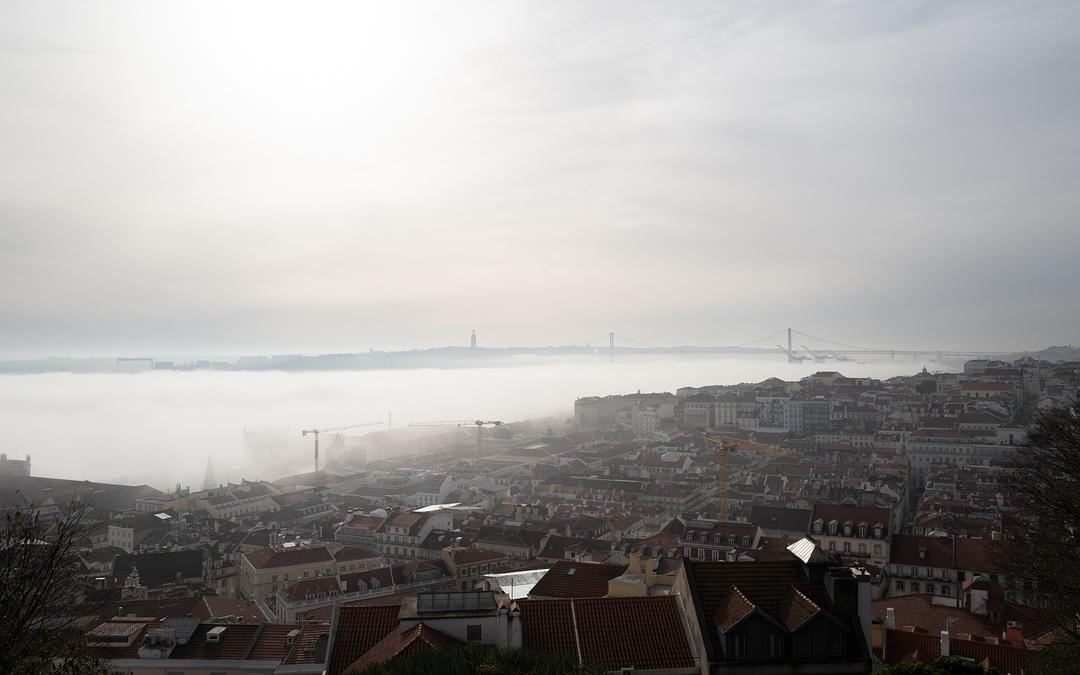
Overlooking the city
Unlike most core European cities, Lisbon is built around hills, and many buildings in the old town have significant elevation differences. You might be walking along and suddenly encounter an upward slope. The road extends into the sky, invading your entire field of vision. I climb the slopes along the roads, trading my breathing rate for elevation gain. I would think I had reached the end of the road, only to find I had merely arrived at a slightly flatter mid-mountain point.
Standing on this precious flat ground, I try to find a suitable gap in the cluster of buildings. Through a long, narrow void, I see more residential buildings diving downwards along the mountains, flooding toward the distant coast, and finally taking flight, rising into the grey-blue sky.
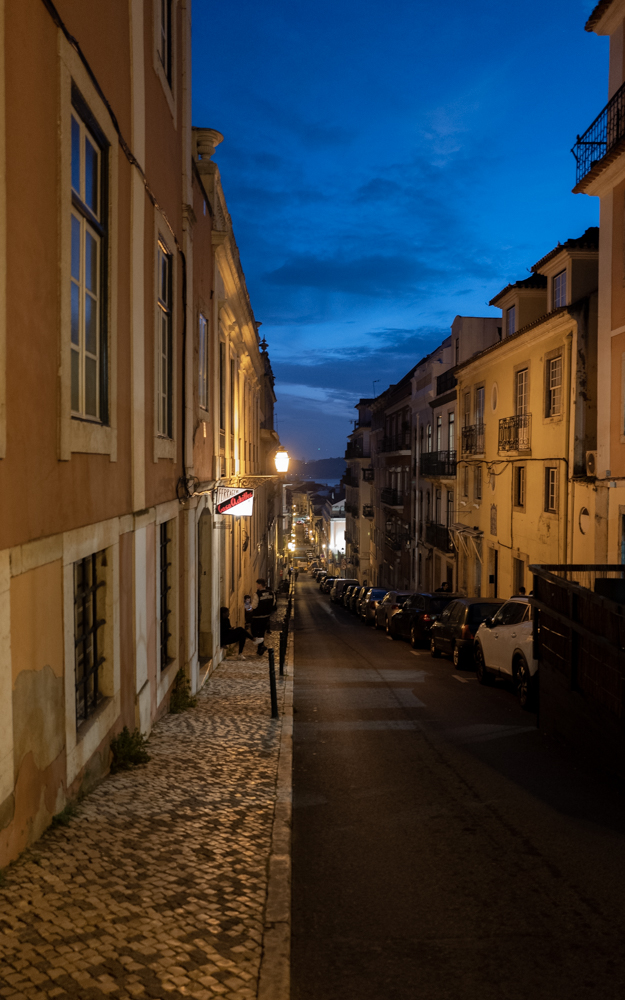
The dive of a massive downward slope
With its three-dimensional and vivid posture, Lisbon interprets what true urban 3D exploration is.
However, excessive vitality also causes quite a few troubles for travel. The hotel I booked was located halfway up a hill. Although there were bus stops nearby, they were either at the top or the bottom of the slope. Every time I returned exhausted, I still had to expend extra physical energy to deal with the additional elevation. But as the number of trips increased, I learned to take shortcuts. Instead of relying on navigation, I kept an eye on the stops, specifically choosing to depart from the station at the bottom of the hill and return via the station at the top. This back-and-forth meant I only ever had to walk downhill.
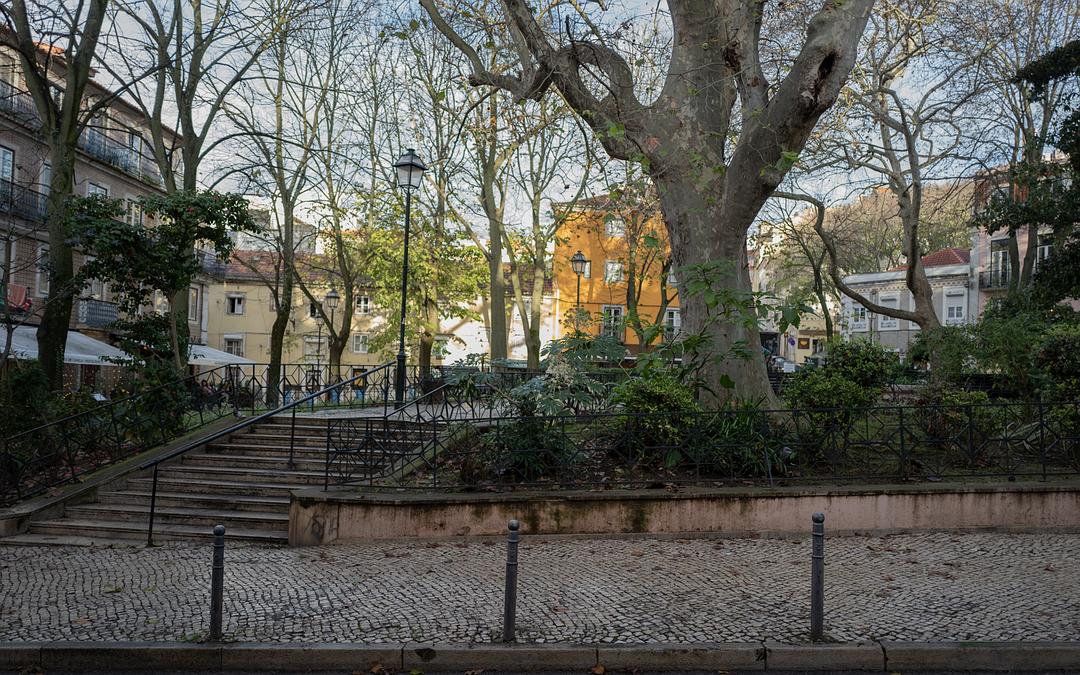
City Garden
Constrained by the narrowness of the city streets, public transportation is designed very uniquely. Common buses have very long carriages to carry more passengers, but because they cannot adapt to the narrow paths, they are only seen on broad main avenues. Once inside the narrow lanes, only special short, chubby buses can shuttle through. They are much shorter than regular buses, with a charmingly naive form. Trams are similar, but compared to the former, the latter has a much longer history. Whether it’s the opening and closing of doors, the interior decoration, or the manual changing of the tracks, they lean more towards a natural mechanical style. This has made them a unique calling card for Lisbon.
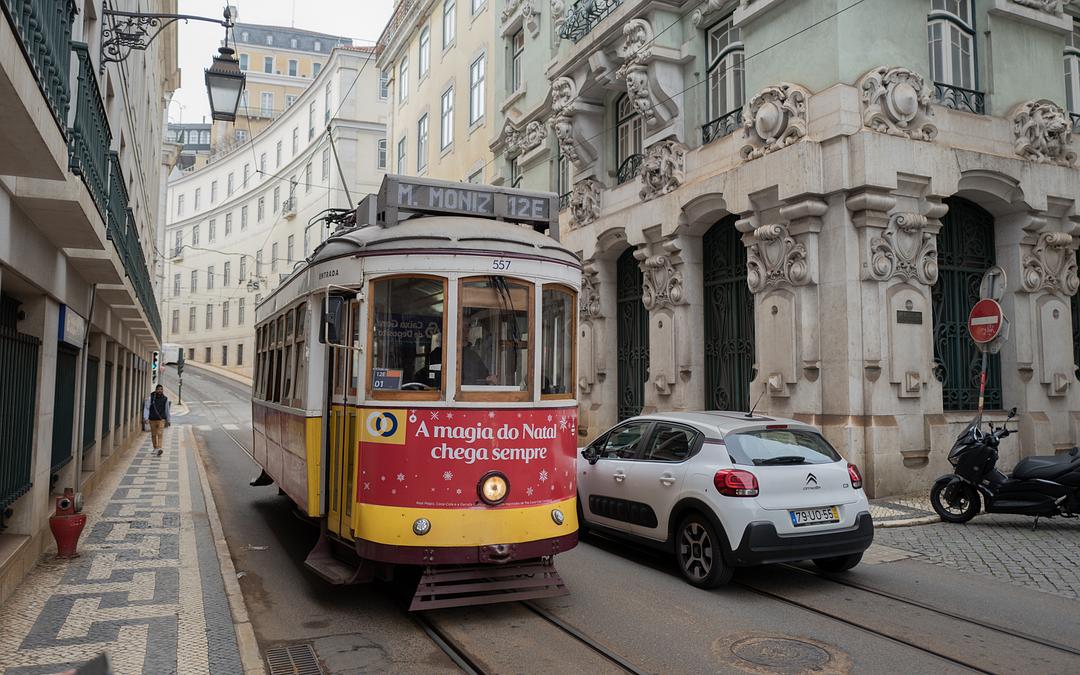
The old Route 12E, still maintaining its form from years past
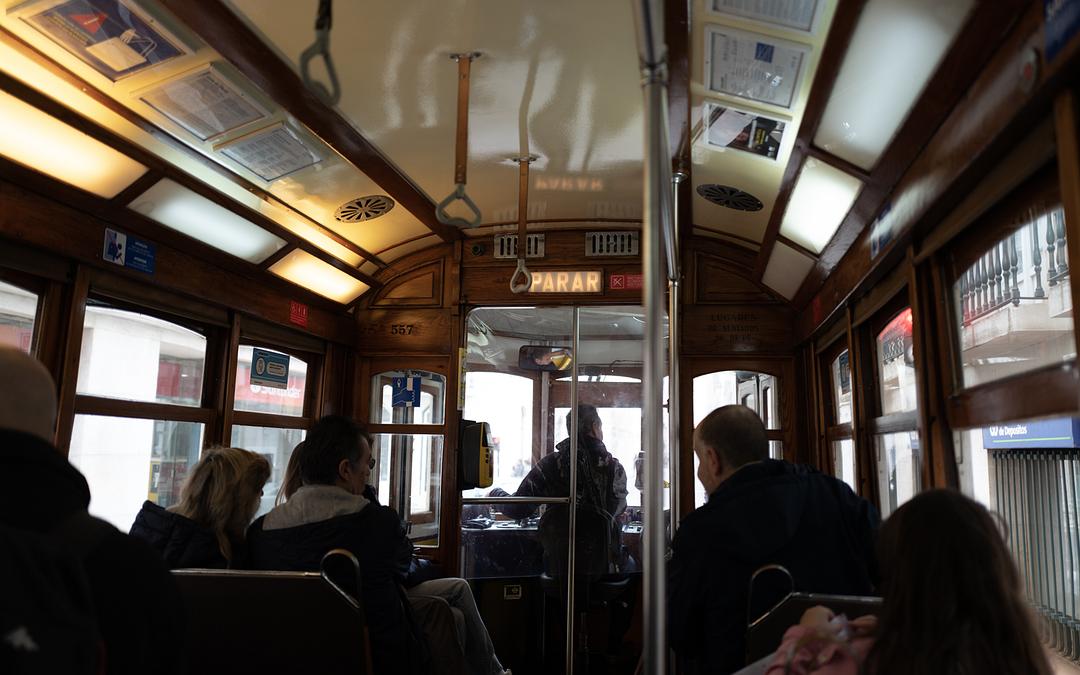
Interior decoration
Lisbon’s architecture oscillates between coarseness and refinement. Due to the sea breeze, black-green stains often appear on the surfaces of stone buildings. They prove that time is constantly extending, like a heraldic crest of personality, giving each building a unique character.
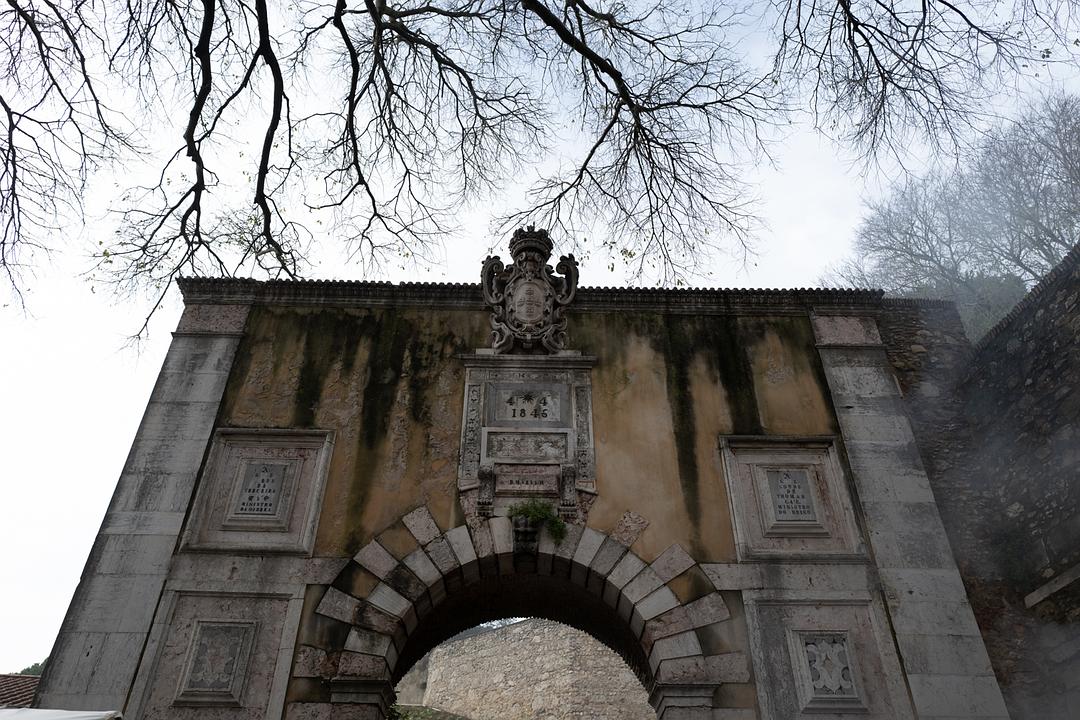
Mottled architecture
Tiles (Azulejos) are another unique landscape of Lisbon. Sometimes they cover an entire building in large sheets, looking magnificent, other times they cover only a small part of a wall, broken and decaying. Although the tiles are rigid squares, the patterns on them are ever-changing. Using mathematical fractal techniques, the patterns can stand alone on a single tile or link with surrounding tiles to form a brand new, massive design. With such magical variations, people never get bored.
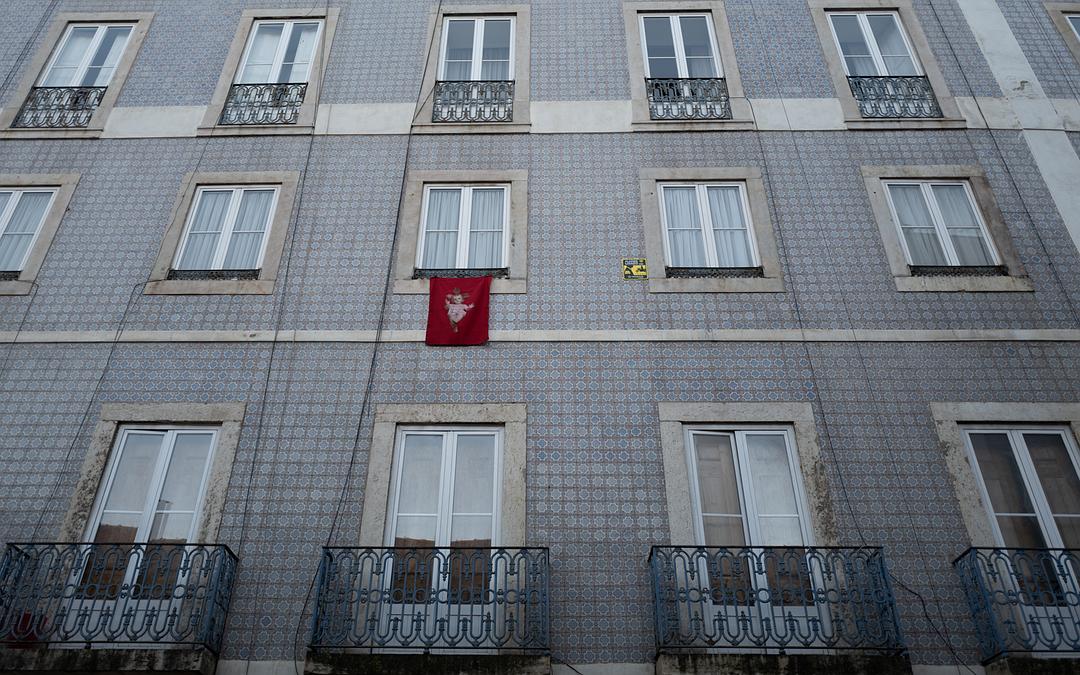
Large expanses of tiles
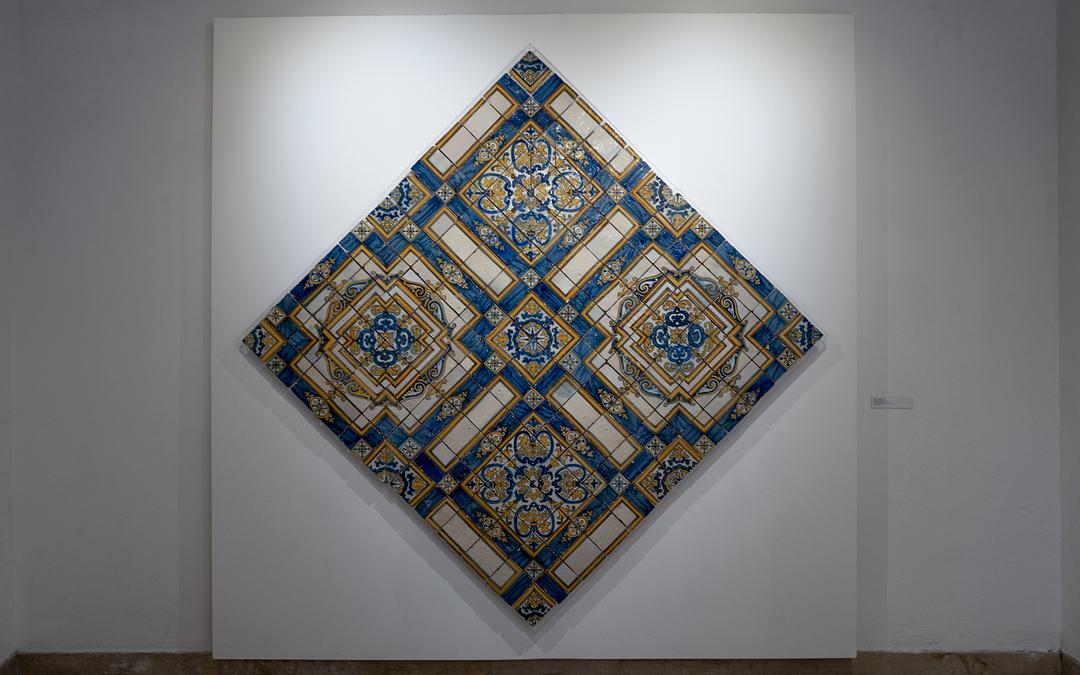
Tile Museum
Similar aesthetics, aside from being influenced by foreign cultures, are also inspired by local plants. Because of Lisbon’s humid and warm environment, local vegetation is exceptionally lush. Even in December winter, one can see patches of subtropical flora. Huge leaves and towering branches grow in the city’s micro-parks. Large and small plant textures have also been adopted into the elements of tiles and architecture. Compared to the Art Nouveau seen in Paris or Barcelona, the fusion of cultural and natural elements here is rougher and more primitive. The transition of details is far less smooth than the former. Although clumsy, it is incredibly cute, radiating a primitive passion.
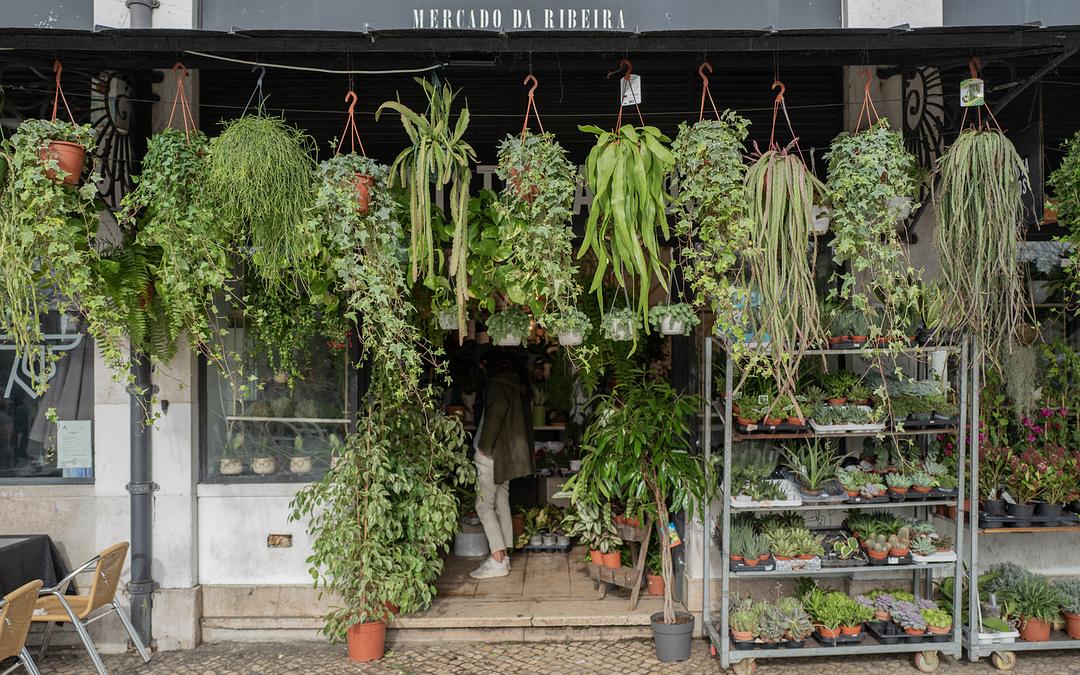
Plants for sale, very lush
Lisbon is a radiator of the oceanic spirit. It not only contains the roughness and wildness of the sea, but the people living here are also summoned by it, sparking exploration and passion. This ensures that even amidst the waves, the city holds infinite exquisite treasures.
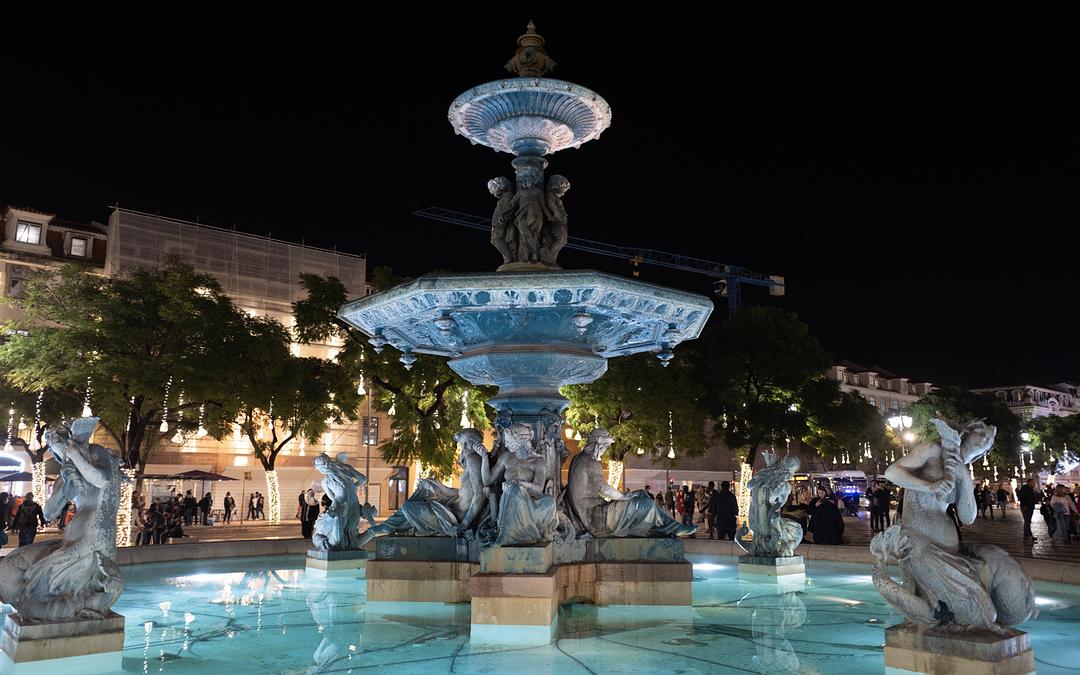
City sculpture fountain
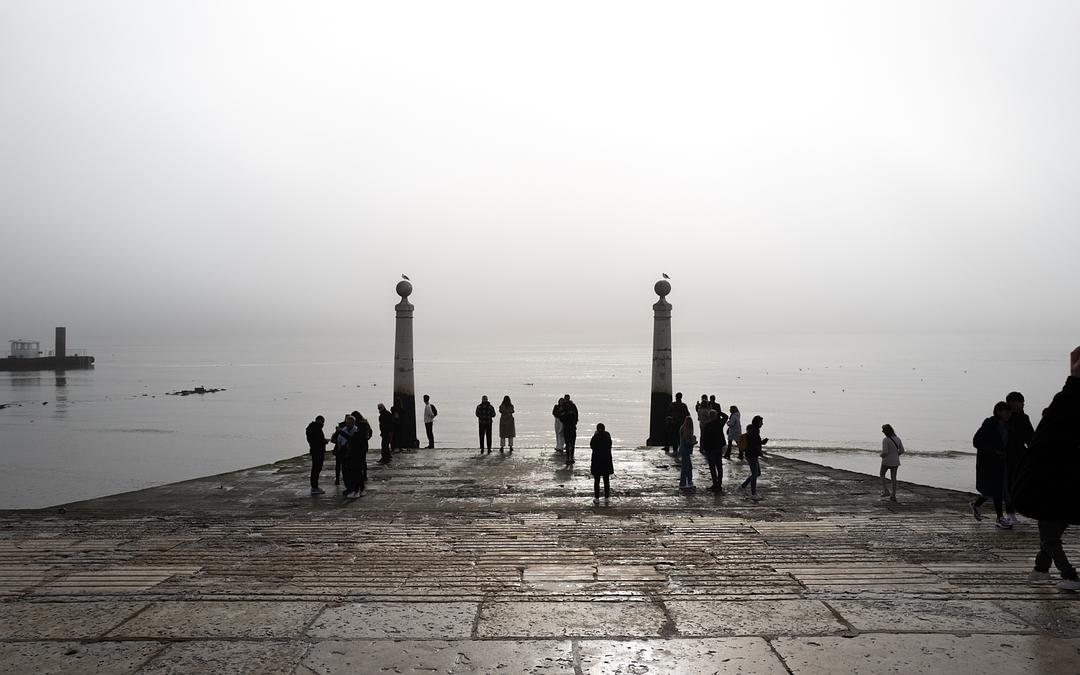
Pier pillars
Transport & Plans
After arriving at Lisbon Airport, follow the signs to the metro station, where there are several ticket machines. For the first time, you need to buy an extra rechargeable card for 0.50 Euros. I bought a 24-hour day pass for 6.50 Euros. You need to swipe the card before entering the gate. The first swipe activates the day pass, which lasts for 24 hours. The recharge machines are generally in the metro stations. If you happen to run out of money on the card and need to take a bus, you can pay on board (but it is more troublesome, so I didn’t try it).
The metro, buses, and trams are the most commonly used means of transportation. The metro is divided into four lines: the Blue Seagull, the Yellow Sunflower, the Green Caravel, and the Red Orient. The airport is at the terminal station of the Red Line and just a few stops on the metro will get you to the city center quickly.
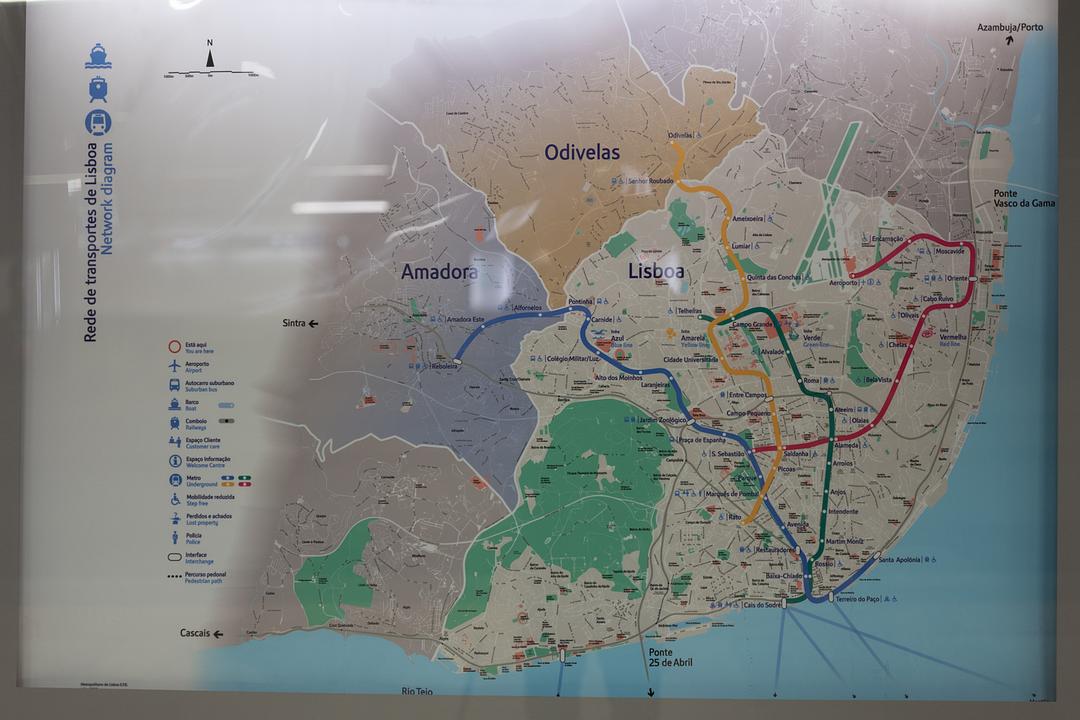
The four metro lines
The hotel I chose was located halfway up a hill in the west of the city, relatively close to Rato, the terminal station of the Yellow Line.
I stayed in Lisbon for a total of three days. On the first day, I went to Sintra, a town near Lisbon, which has many castle landscapes. From the center of Sintra, you can also reach Cabo da Roca, the westernmost point of continental Europe. On the second day, I visited famous attractions in Lisbon city center: the National Tile Museum, the Cathedral, and the Carmo Convent, as well as the old town, riding the Santa Justa Lift. On the third day, I visited the Jerónimos Monastery.
Pena Palace in Sintra
Looking at the map, Portugal appears as a long strip. The distance from east to west is not very far. Departing from Rossio train station in Lisbon, a one-hour suburban train ride takes you to the station in Sintra.
It is worth noting that tickets for this train, as well as bus tickets upon arriving in the suburbs, need to be purchased separately. My plan was: go to the manual ticket counter at Rossio station and buy a “Train and Bus Ticket.” I recall the price being around 16 Euros. This ticket includes the round-trip train fare from Lisbon to Sintra and the local bus fare in Sintra. Of course, you can choose to buy them separately, but I chose the lazier method.
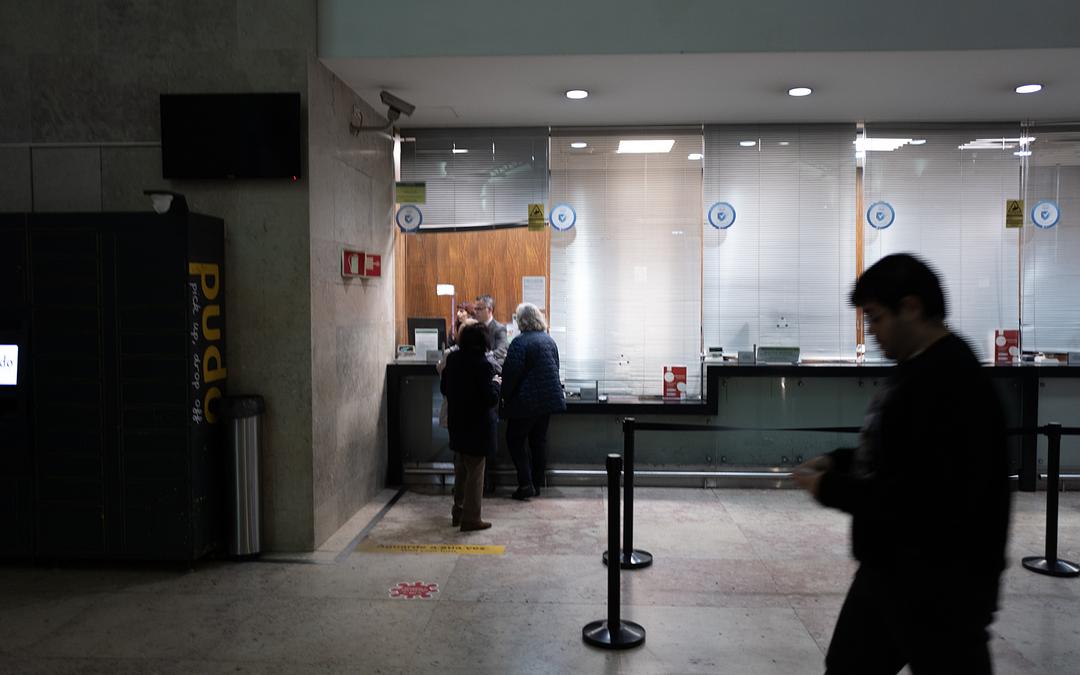
Ticket office in the early morning
At around seven or eight in the morning, I arrived at the manual ticket counter. There was hardly anyone there. After briefly communicating with the ticket seller, he gave me a yellow card ticket. With this card, I could ride any bus in Sintra.
The suburban railway line is a bit dilapidated—not just the carriages, but the scenery along the way as well. Without the glossy exterior of Lisbon city surrounding it, the whole presents a sense of desolation. Aside from tourists, the locals in the car were of various skin tones and ethnicities, dressed very plainly. It truly restored the most vivid, life-like posture of Portugal.
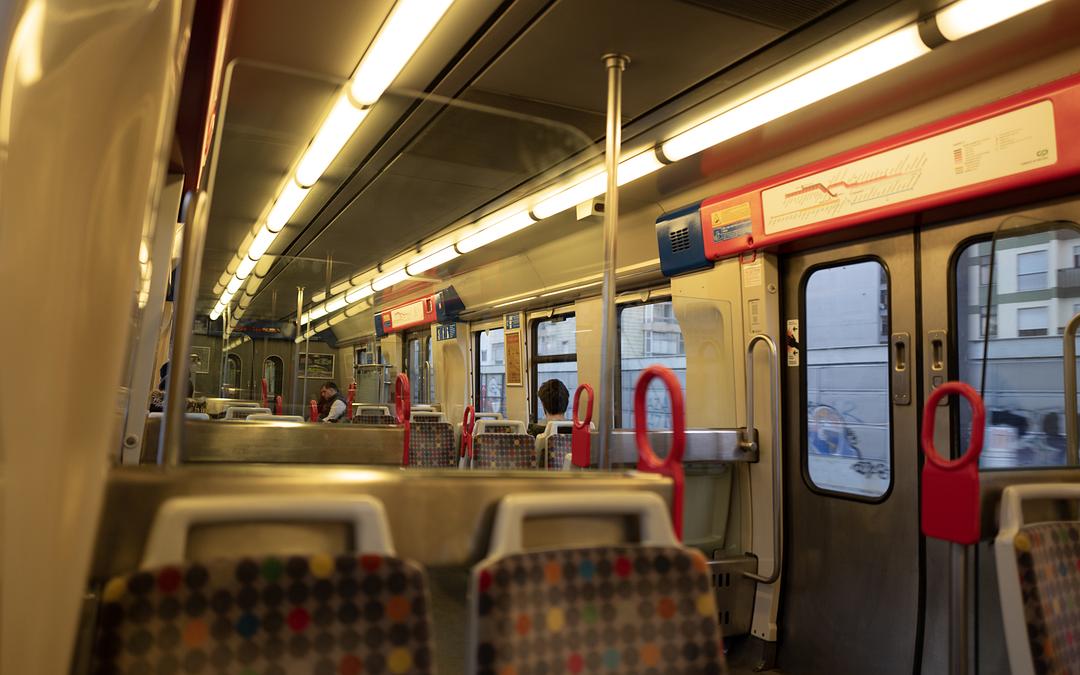
Suburban railway
Sintra’s central train station is not big. “Central” is actually an excessive boast. Small bungalows stuffed with mini service offices that can only squeeze in a few employees. Conversely, the colorful tiles inside the station building are very eye-catching, even somewhat incongruous.
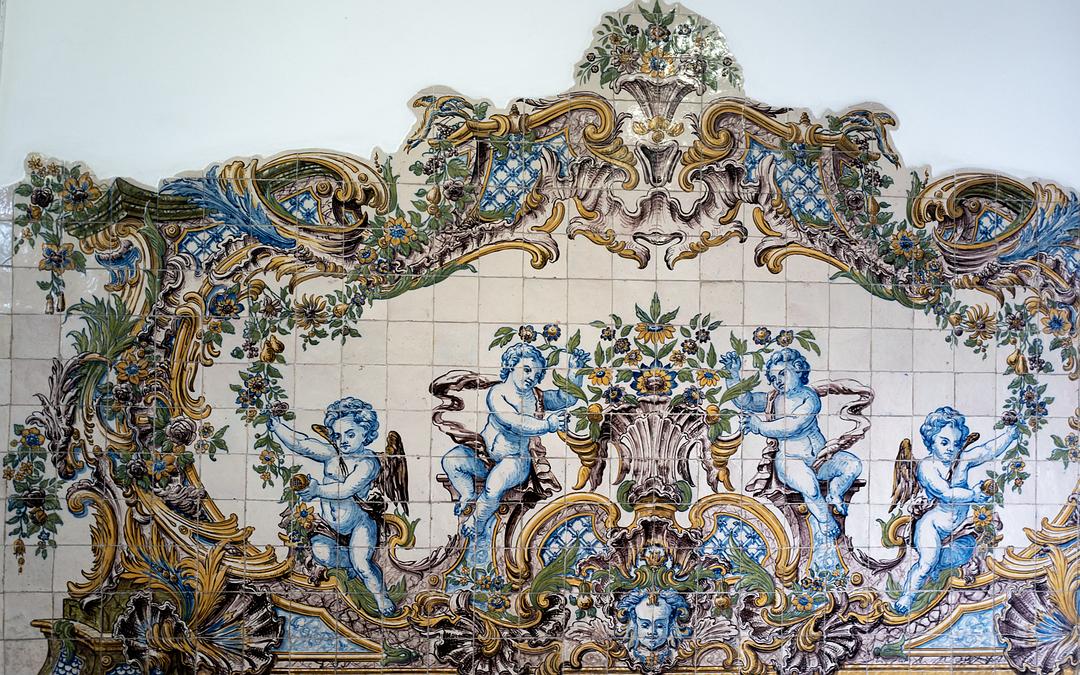
Walls inside the train station
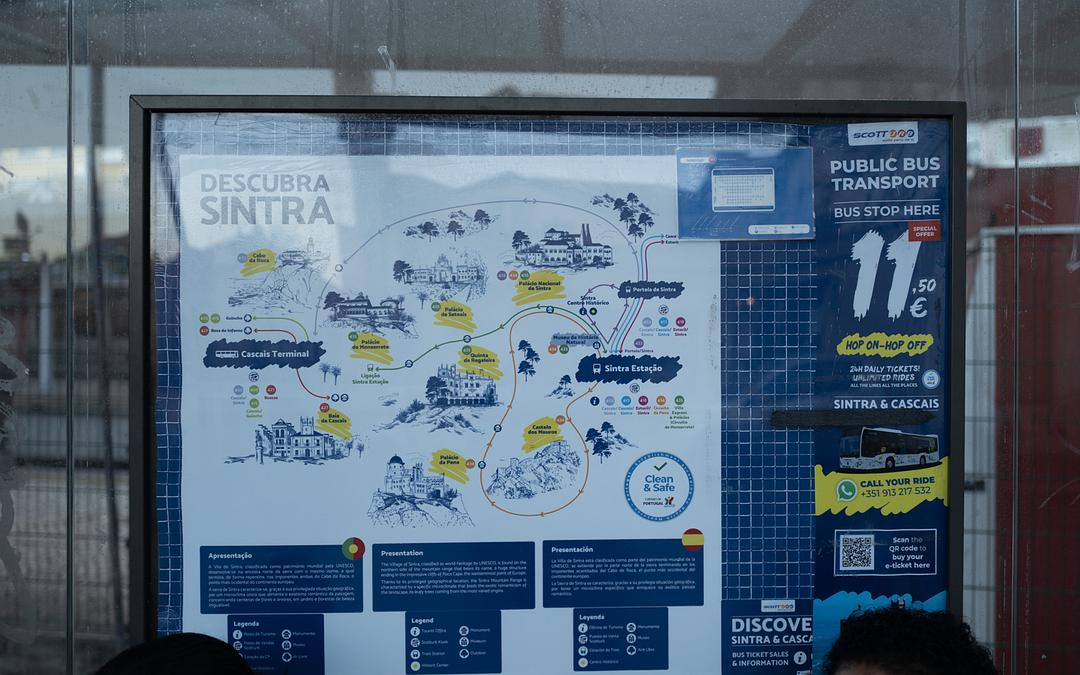
Sintra route map
The bus station is right next to the train station. Buses are the main tool for visiting various attractions. Although you can choose to drive, the rugged and narrow mountain roads are a huge challenge to driving skills. It’s better to leave the bumps to the experienced bus drivers, consider it a kind of fun in the journey. The bus route is circular, so the pick-up and drop-off locations are the same—no need to worry about not finding the station.
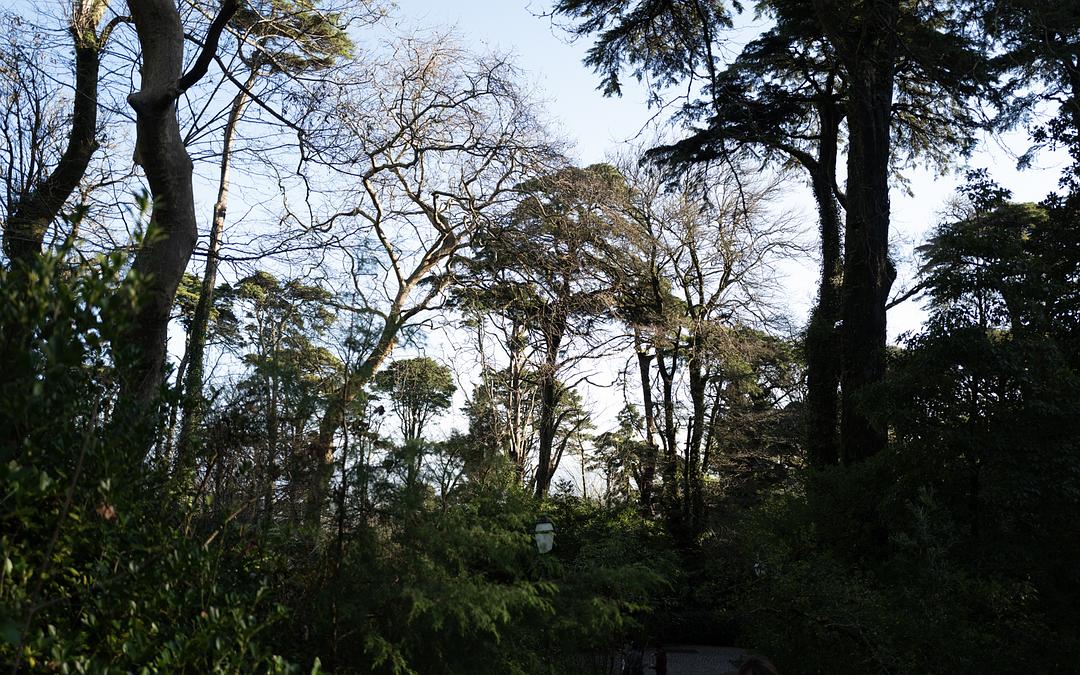
Lush vegetation on the mountain
Pena Palace is located on the highest mountain in the suburbs. When the weather is good, climbing up to Pena Palace allows you to overlook all of Lisbon.
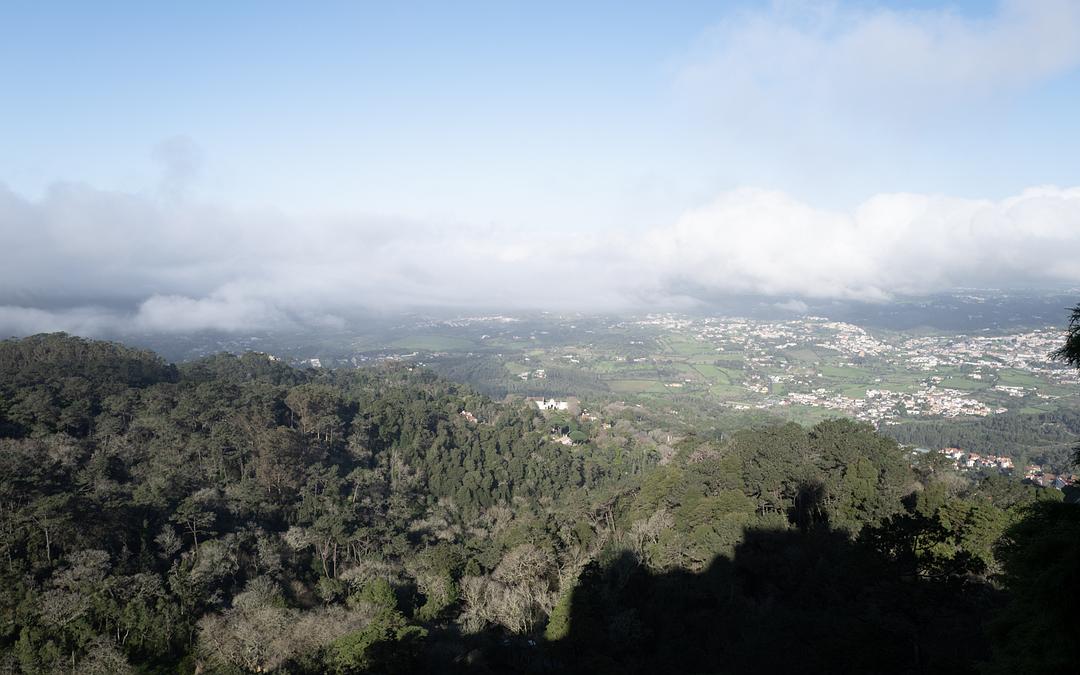
City shrouded in clouds and mist
You can choose to buy tickets online or purchase them on-site via automatic ticket machines. I went quite early, so there were few people near the ticket machines, but by noon, the line was very long. When buying a ticket, you need to choose a time to enter the castle. If you go too early, even if you can enter the park, you still need to queue in front of the castle and can only enter at the scheduled time. After entering the castle, there are two or three more ticket checks, so remember to keep your ticket at all times.
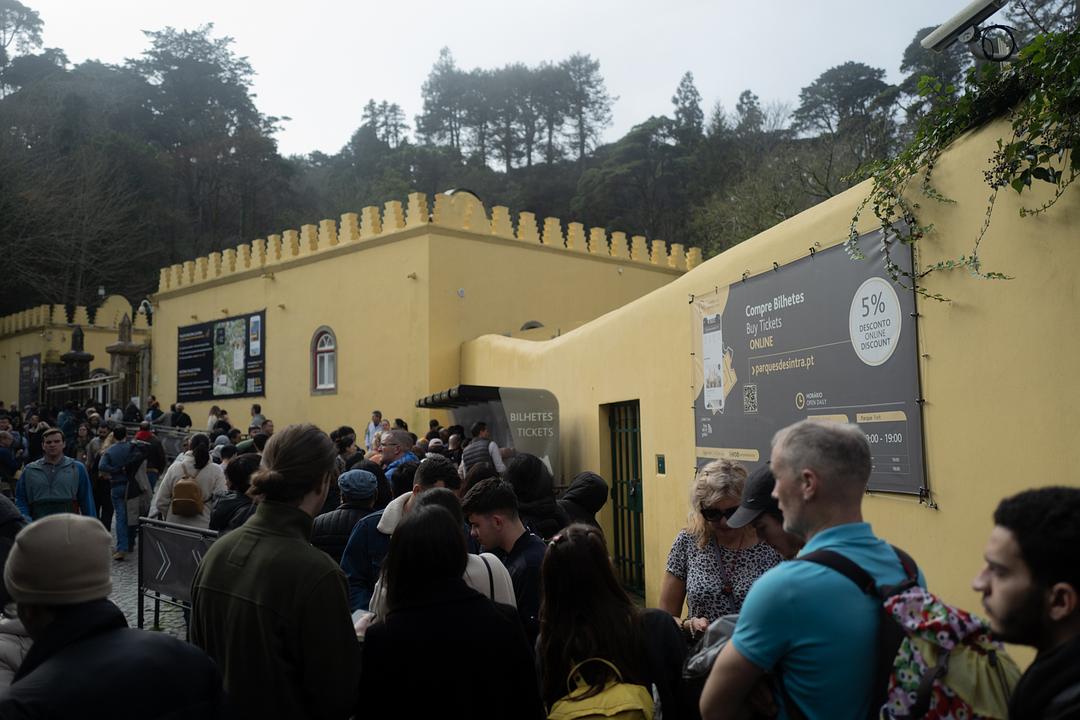
The ticket check at noon, full of people
I find it hard to evaluate the style of this palace architecture. Three-dimensional geometric shapes of different colors and forms are spliced together, yet the sculptures and decorations on the door frames and walls are very delicate, as if trying their best to cover up the dissonance brought by the splicing.
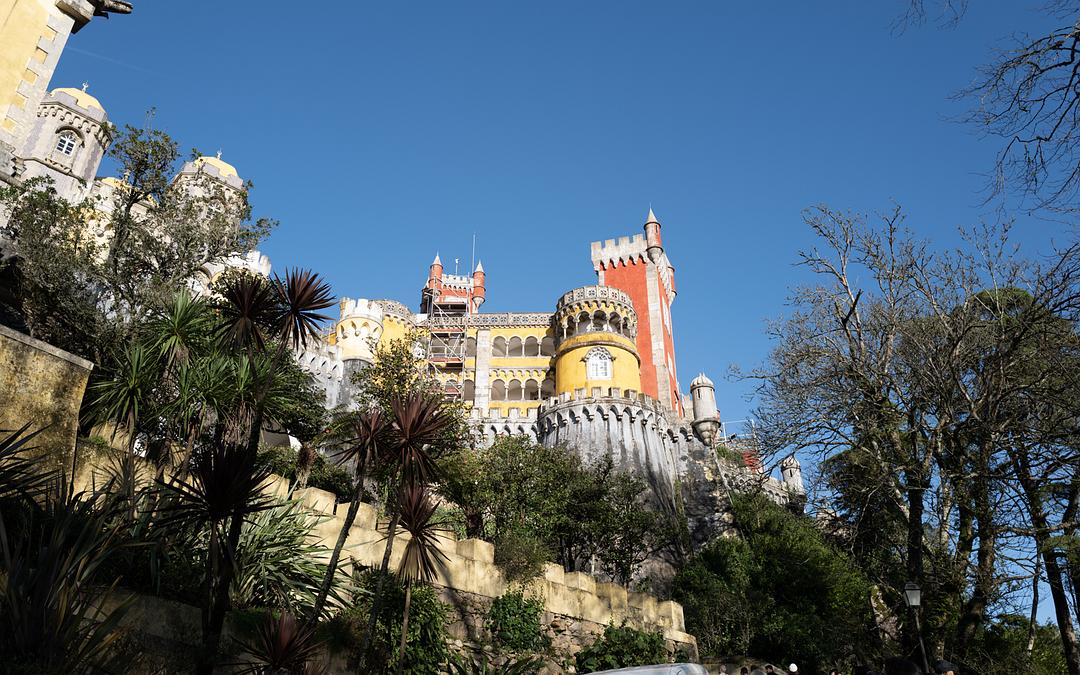
Exterior wall of the palace
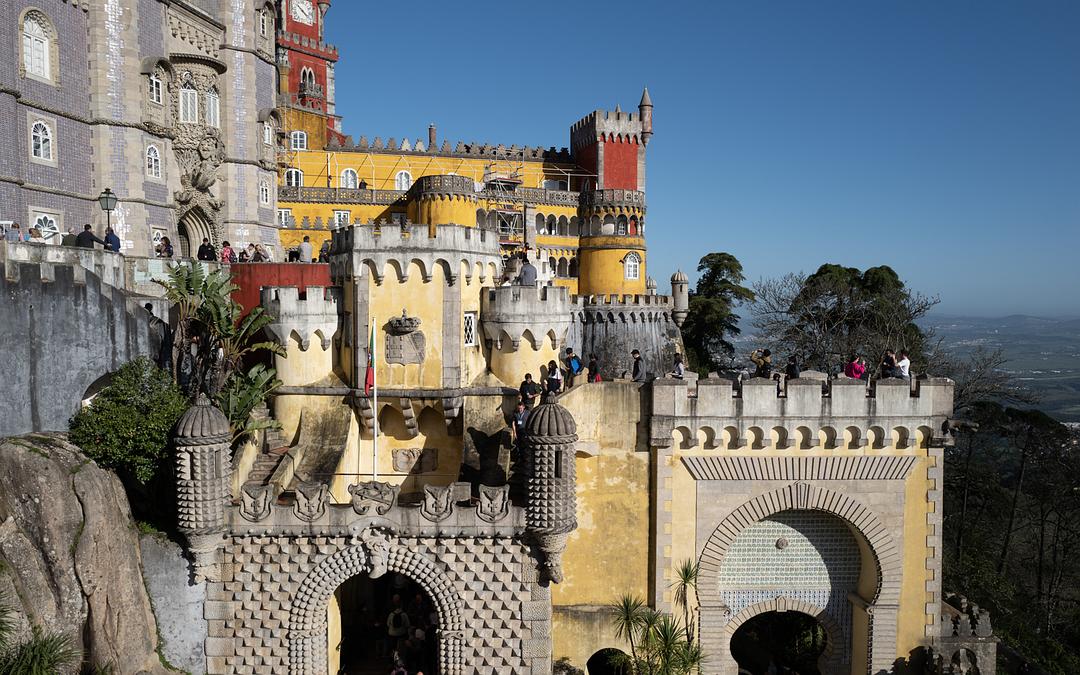
Mix and match of different colors
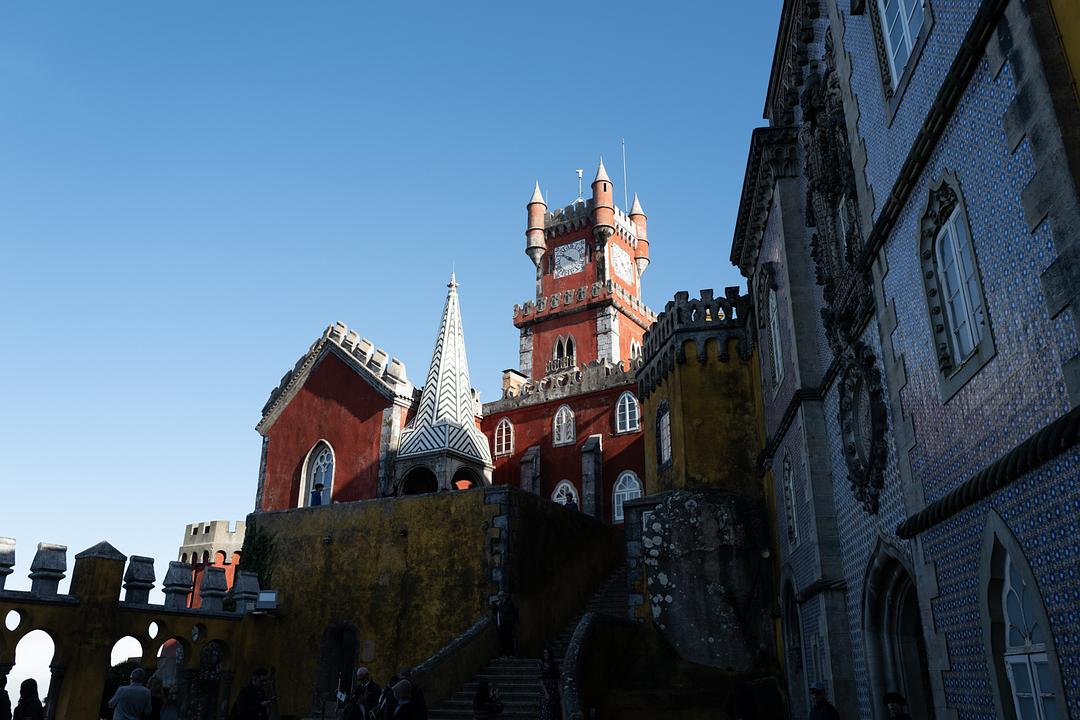
Red tower
Romanticism can be divided into many types: there are the perfectly ideal ones, and the trivial, intuitive ones. I’m not sure if it has to do with the German architect, but it vividly displays what “it looks like in the eyes of outsiders” from a very intuitive perspective. This interpretation and elaboration of local culture by foreign culture is also a very important theme in the cultural field. This castle is like Dürer’s Rhinoceros. Aesthetics have been placed in the second position, and what matters is magnificent imagination and creativity.
Due to itinerary planning, I hurried down the mountain after visiting the castle. As for the remaining gardens and other interesting castles, I will visit them next time I have free time.
Churches and Monasteries
I am not keen on religious culture across Europe. For the frequently appearing religious buildings, I just skim through them, merely watching the spectacle.
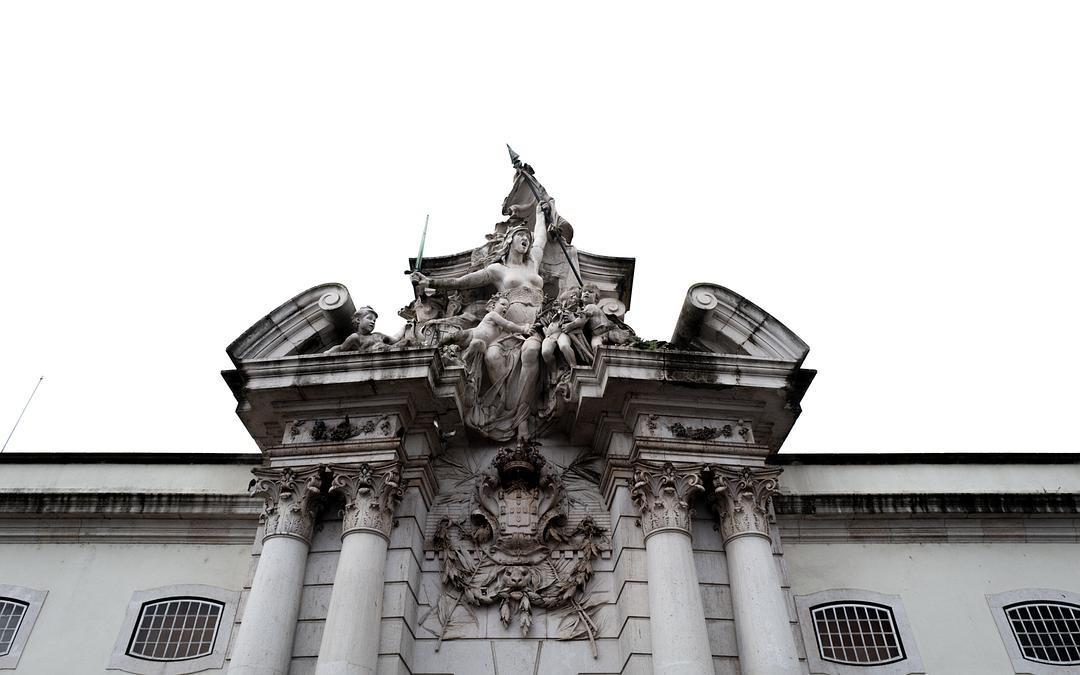
Sculptures on the building
In Lisbon, besides the Cathedral, there are two very famous monasteries. One is on the edge of the city center, called the Carmo Convent. Because of an early earthquake, it lost its roof, leaving only walls and flying buttresses. The other is in the west of the city along the coast, called the Jerónimos Monastery.
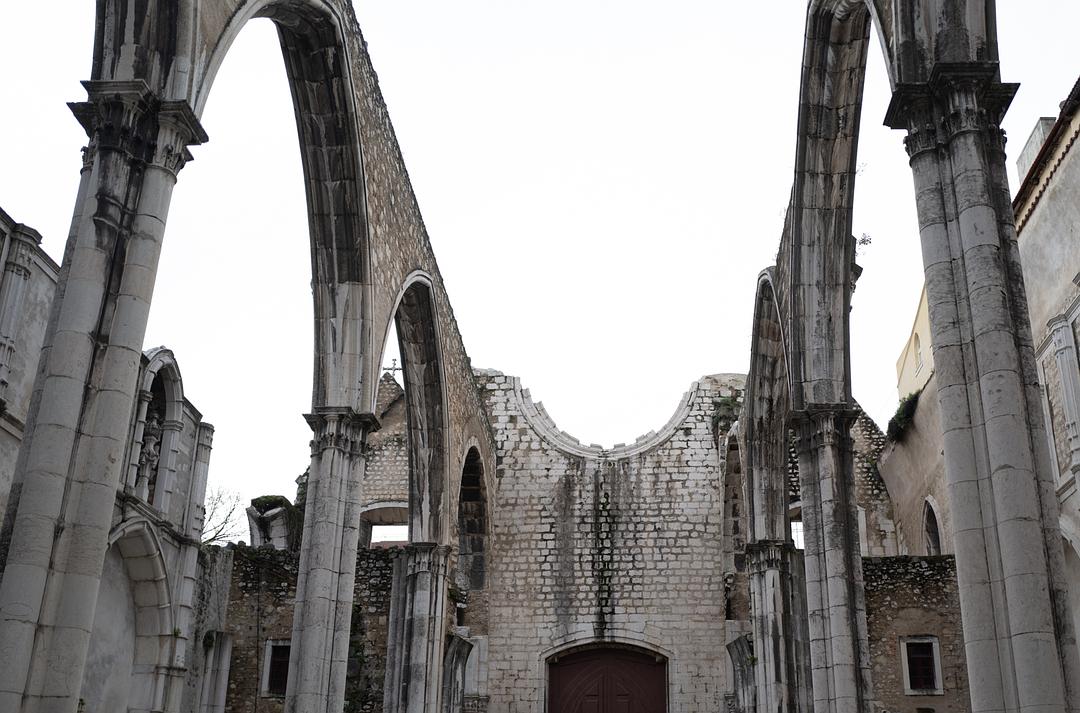
Ruins of Carmo Convent
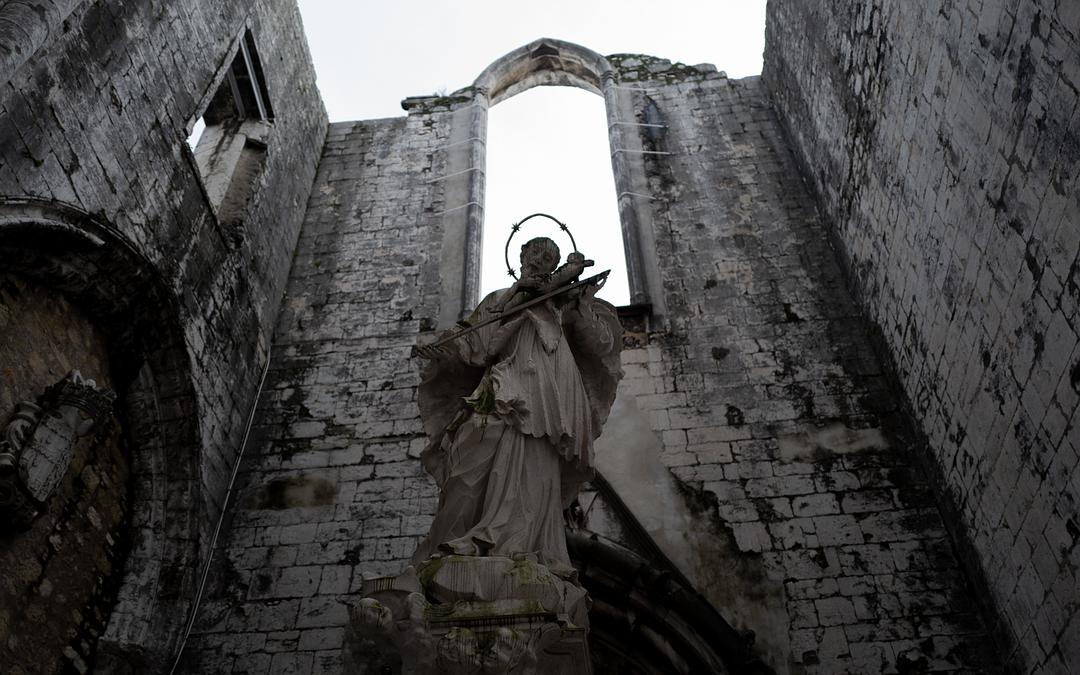
Sculptures of Carmo Convent
Roughness and wildness are the main themes. Even the exquisiteness that can bring a sense of religious sanctity is carved very intuitively on the façade of the building. The main body is like a thick, naive giant blue whale. Entering its body, you can see bone-like architectural structures piercing the ceiling. It seems placed there unadorned simply to comply with the laws of physics. Of course, it is not without ingenuity, but there is more “thought” than “craft.” That primitive power in human thought is exposed with nowhere to hide, embodied in the ornamentation of the architecture.
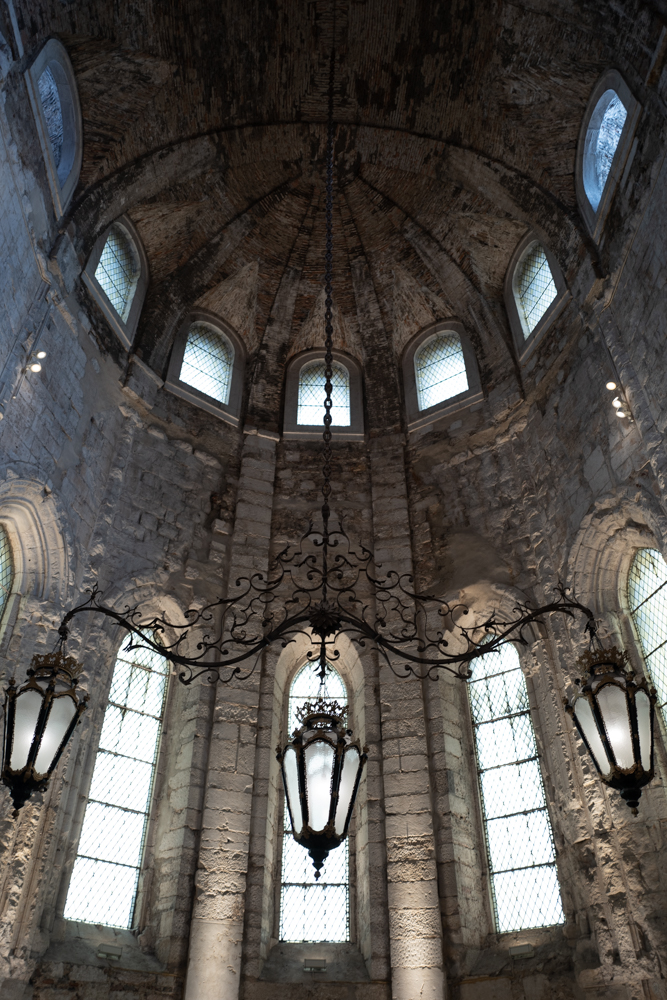
Interior of Carmo Convent
The heart of the ocean constantly influences these buildings. The human imagination infected by it is the source of inspiration for realizing these structures, and to resist the powerful force of nature, every brick and stone in the building inevitably becomes heavy and coarse. Over a long period, it is like a silent war—construction on one side, destruction on the other. From the mottled wall bricks and jagged cracks, we see the bits and pieces of this massive tug-of-war.
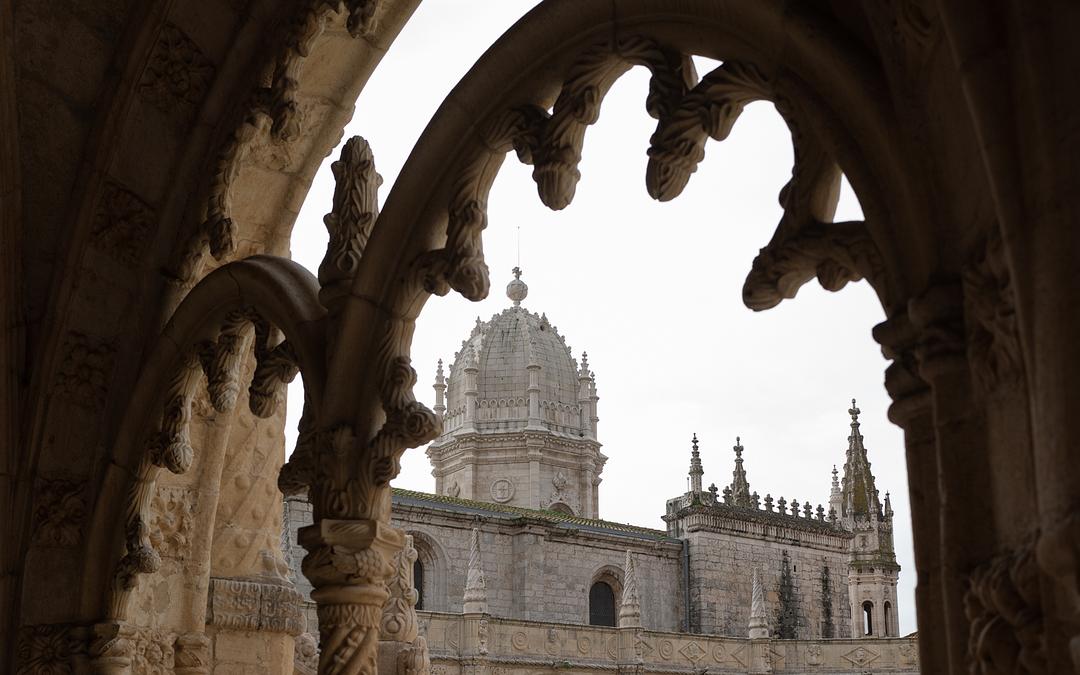
Tower of Jerónimos Monastery
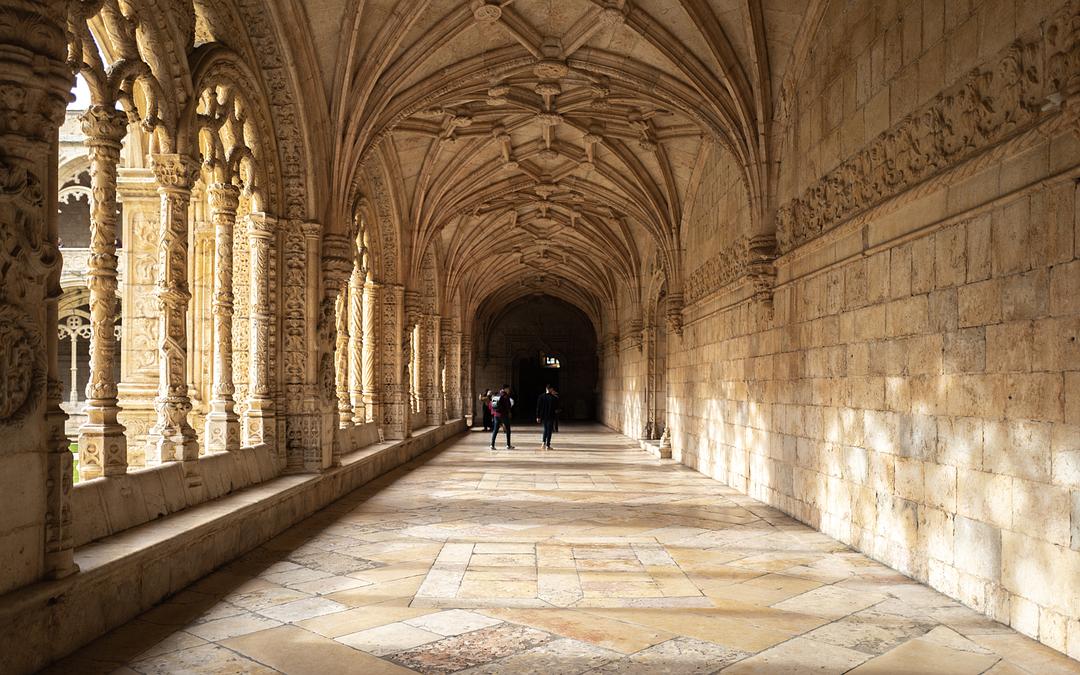
Interior of Jerónimos Monastery
Today, these monasteries have become history, abstract knowledge, and symbols. They are either empty or converted into museums to house historical artifacts. Commercial modifications have led to the loss of many details of how people lived at the time. The accumulation of too many tourists makes these buildings—solidified by money, blood, tears, and faith—lose much of their flavor. Only by tasting carefully can one smack a hint of flavor from them.
Nightfall
Lisbon’s sun sets below the sea level, and night falls low. People show no lingering attachment to the sun’s exit. Instead, they look forward to it, eagerly awaiting the arrival of the night.
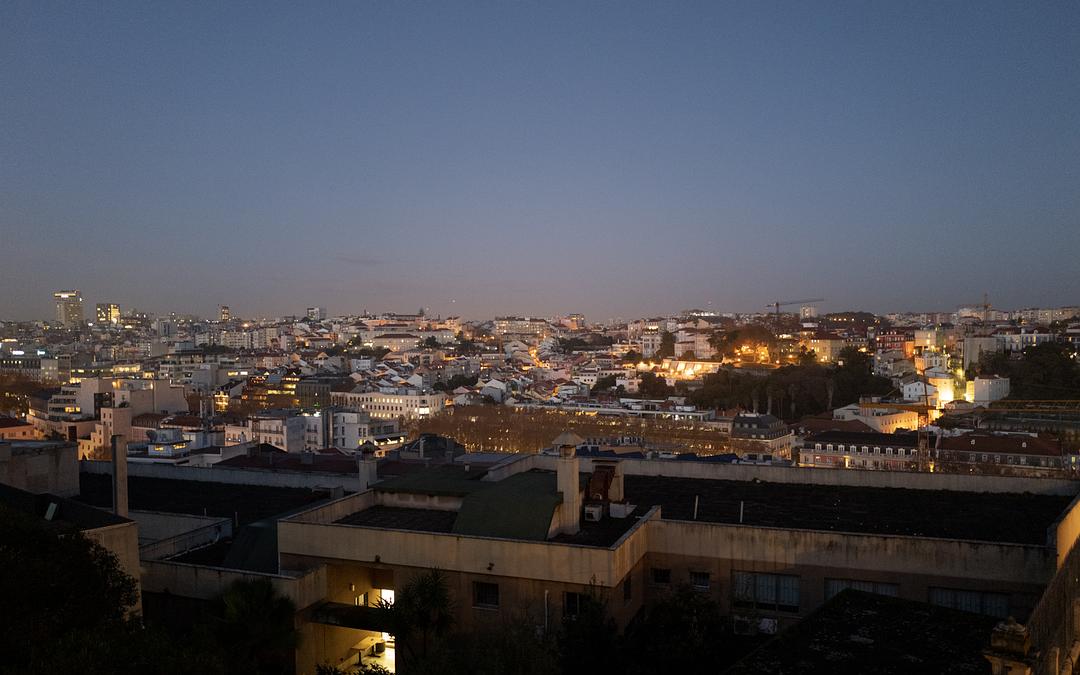
The city under nightfall
There are two kinds of lights hanging overhead: one is the common street lamp, standing neatly on both sides of the main roads. The other is the bright yellow bulb hanging on the high walls by the small paths, making eyes dazzled. They have built-in sensors, when people walk underneath, the light suddenly flashes, as if a god is floating behind you, eagerly rushing to help.
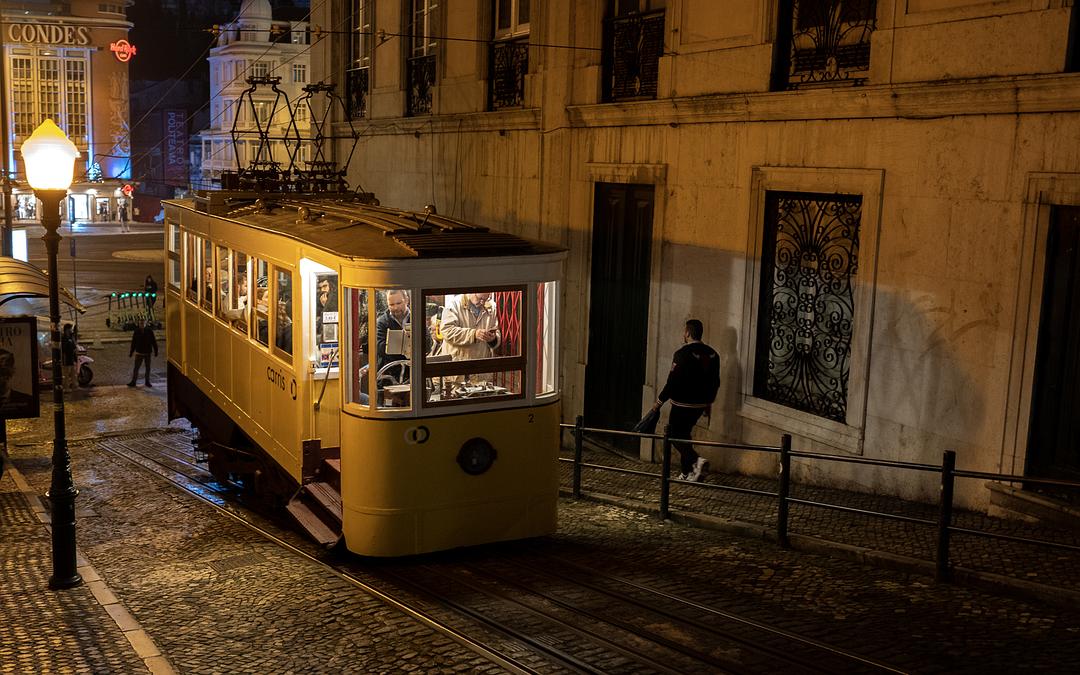
Lamppost and tram
The colorful darkness continues to thrum. The main roads and small paths offer two different landscapes and must be spoken of separately.
On the main roads, the lined-up shops have closed their doors, replaced by bars and restaurants. The style is usually high-end, places frequently visited by wealthy adults. Constrained by the narrowness of the buildings, restaurants are often rectangular, embedded in the architecture. On one side is the entrance and exit, on the other is a kitchen enclosed by transparent glass. Looking in from the outside, it is very deep, like the ocean, activating the exploratory desire of the taste buds.
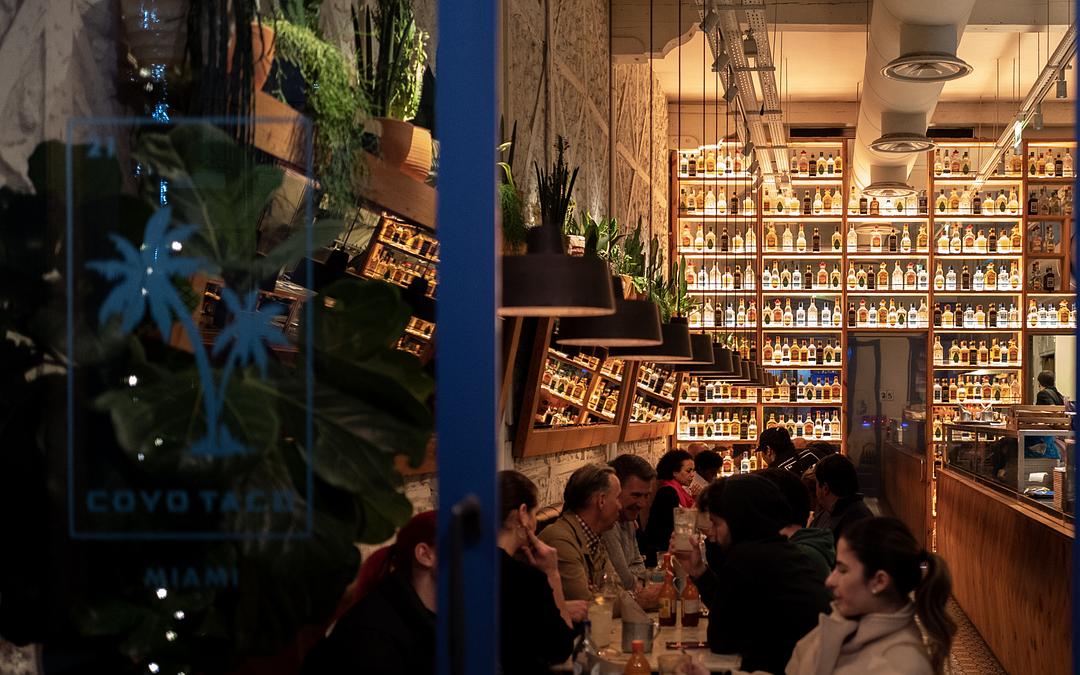
Long and narrow restaurant
The meandering alleys embody the true charm of Lisbon at night.
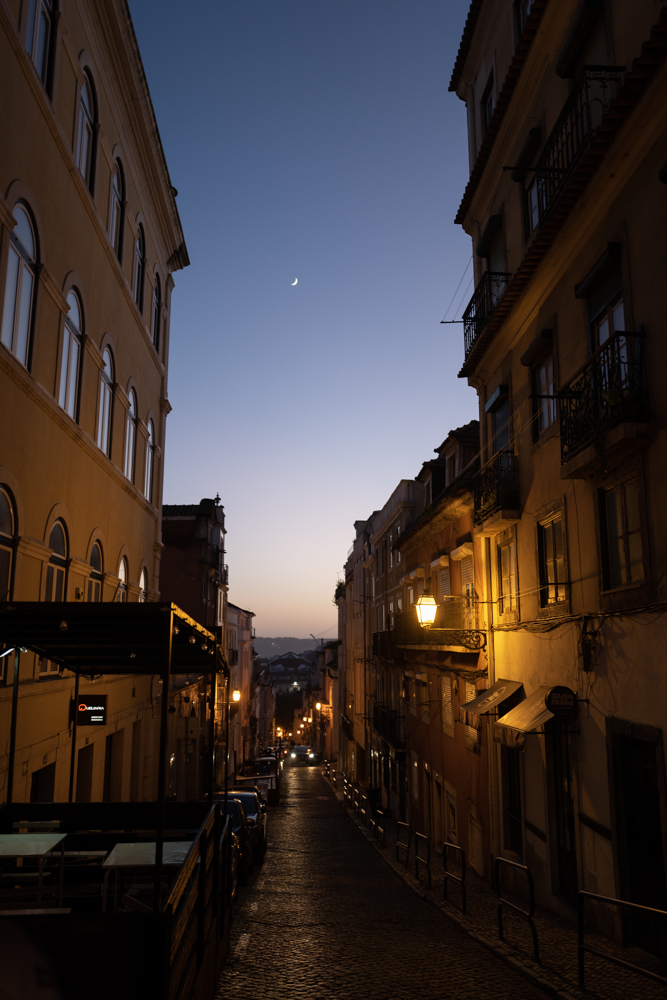
Unlike the suits and leather shoes on the main avenues, the dance in the small paths is young and dynamic. From the moment you enter, you are immediately summoned. The streets are extremely narrow. The residential buildings on the left and right are very towering, ultimately leaving only a slit through which to look up at the sky. Stones the size of a child’s palm pave roads that burst forth with fine, light drumbeats, thump-thump-da-da, going up and down with the undulation of the hills. The restless rhythm does not stop. Instead, it resonates with the tiles on the walls on both sides. Lights mix with moonlight, and the tiles constantly change color, jumping and shuttling between the buildings—sometimes growing larger, sometimes smaller, sometimes dense, sometimes sparse. While the day overflows with color, the night becomes weird, unpredictable, and elusive.
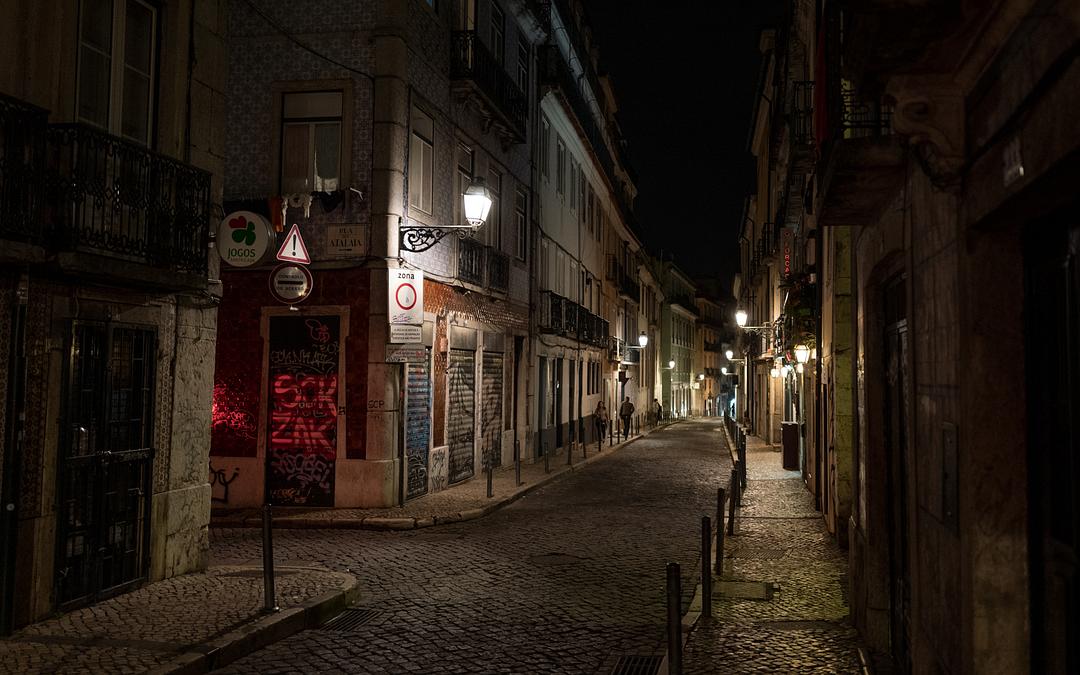
Alleys of Lisbon
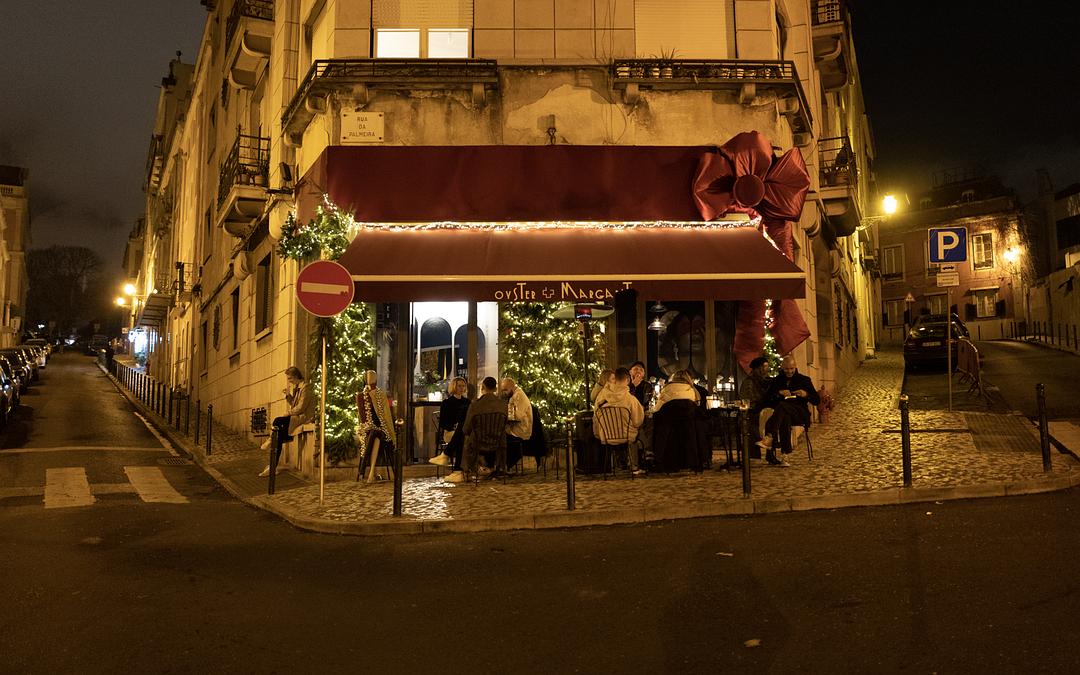
Sitting outside drinking
Noisy rhythms fill the quiet paths of the late night, constantly inciting people to explore deeper. Bars and restaurants are like jelly beans of mixed flavors. The bag wasn’t held steady, a hand shook, and they scattered irregularly everywhere. The rigid rules of adults lose their effectiveness here. The fog of cigarettes, the sound of laughter, showgirls hidden behind heavy doors, exotic customs… The long, drawn-out alleys are like a magic pocket, bursting with all kinds of novel and fun elements, teasing the burning curiosity of young people.
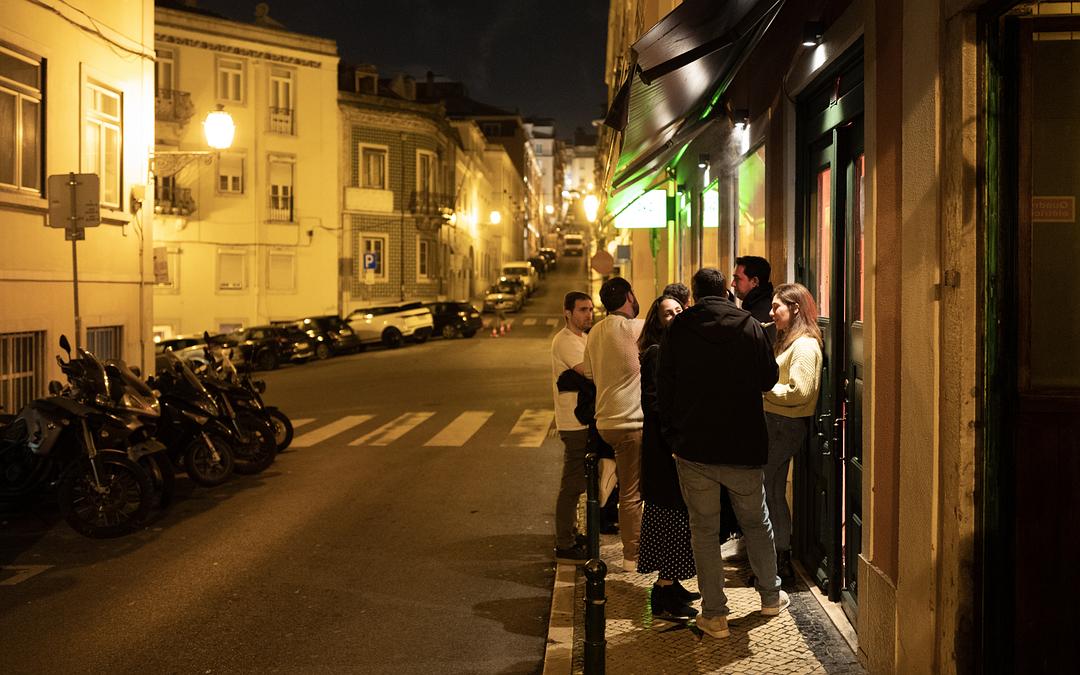
Standing outside drinking
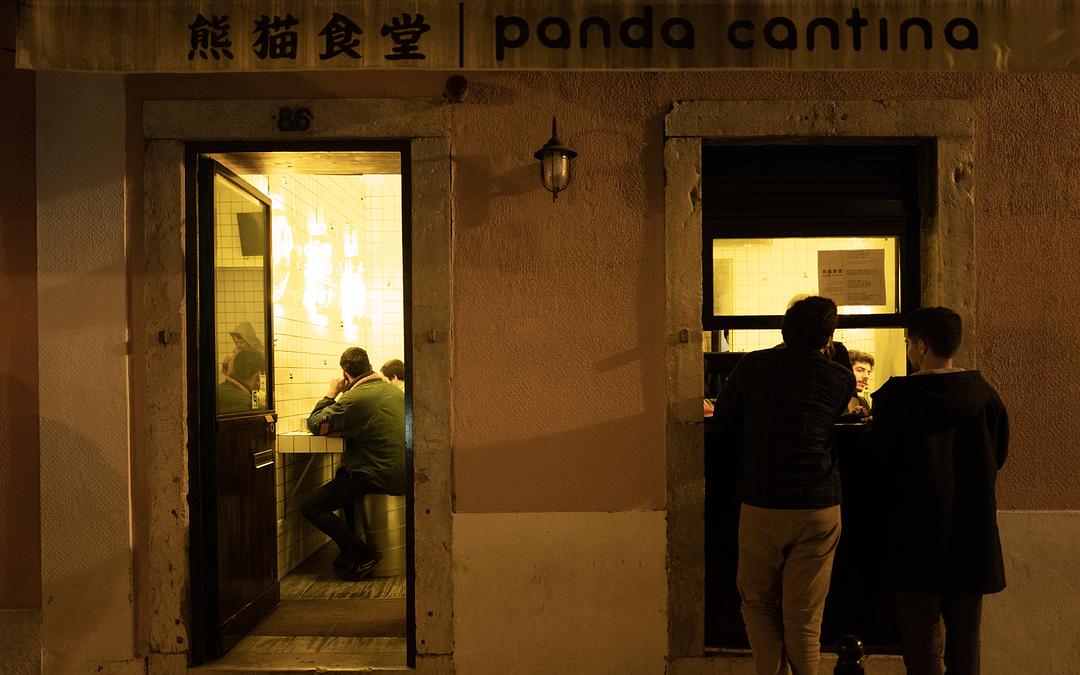
Panda Canteen
Turning the corner of the street, the mini garden is a whole other world. Scattered paths converge at the central fountain, and the remaining space is filled with greenery. Huge leaves and dense bushes act like a hallucinogen, making it impossible for me to distinguish between winter and spring. The open view combined with the dim lighting makes even the tallest plants seem to regress into moss in the corner, becoming closed-off and introverted. In this moment, I suddenly recall childhood scenes in southern China. Although the white walls were tall, covering the sky, they had their unsightly side. The base of the wall near the ground became black and greasy due to dampness. Moss grew wherever there was a crack, savage enough. After looking at it for a long time, I got used to it, and finally, it settled into memory, surprisingly giving birth to a long-lost sense of peace and comfort.
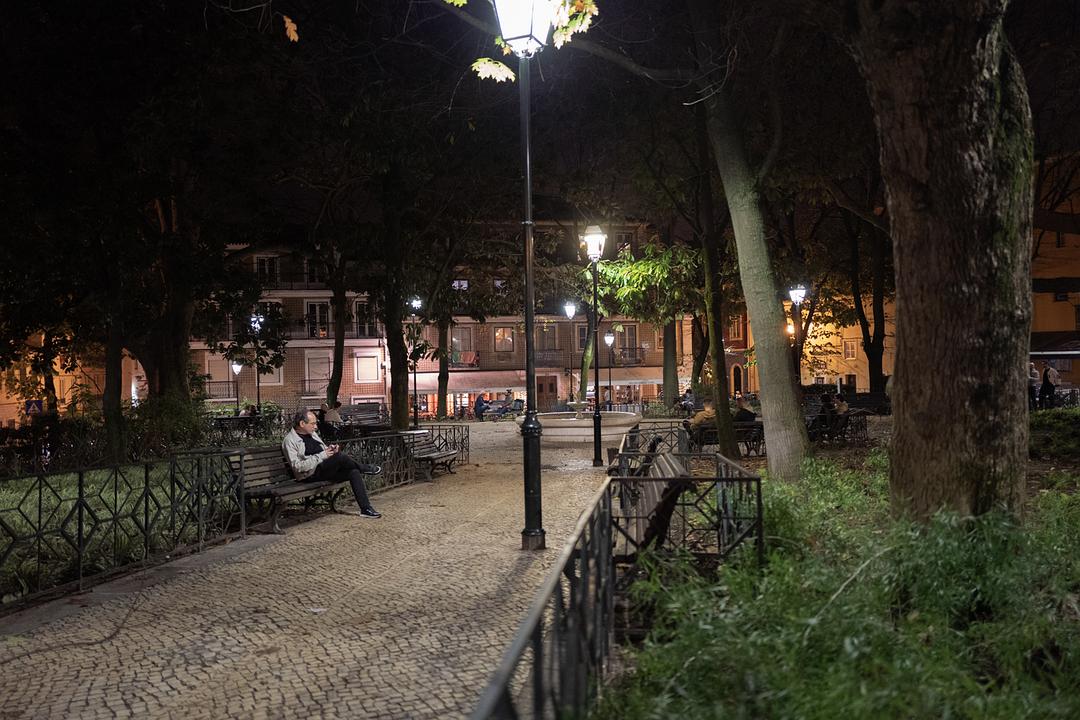
Garden in the early hours
The small kiosk next to the mini garden scatters a white fluorescence like heaven, selling not cigarettes or newspapers, but what I call the source of spirit and inspiration—alcohol and snacks. Although there are not many types of wine, it is completely enough to console different souls. The guy inside wears a smile, leisurely satisfying everyone’s needs. That night, he became a savior.
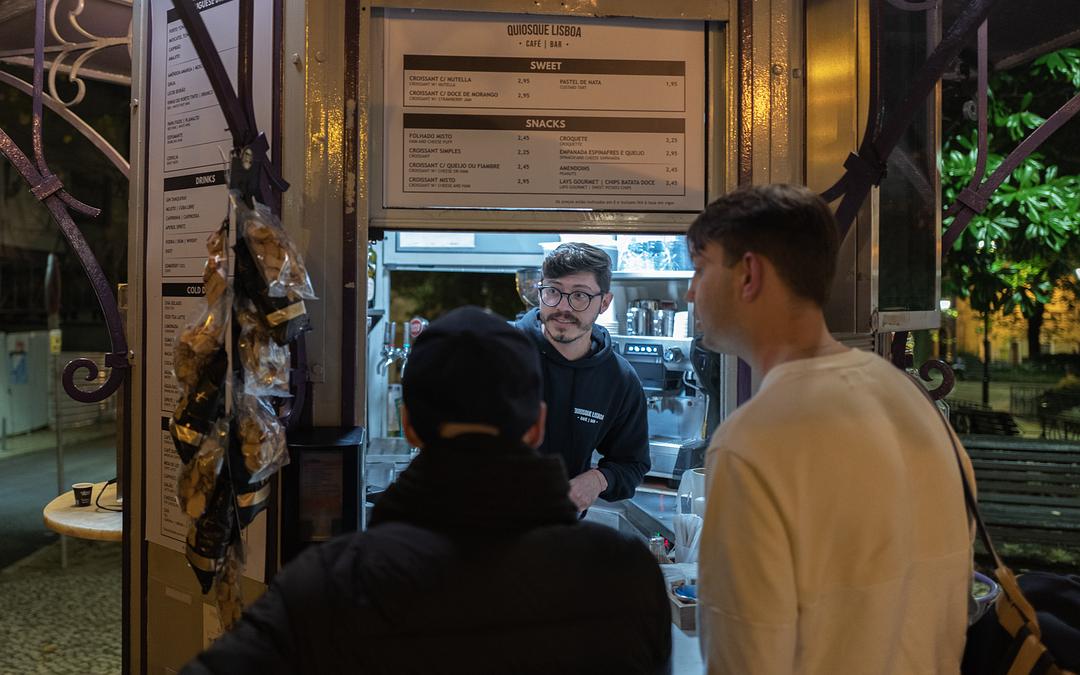
Soul Replenishment Master
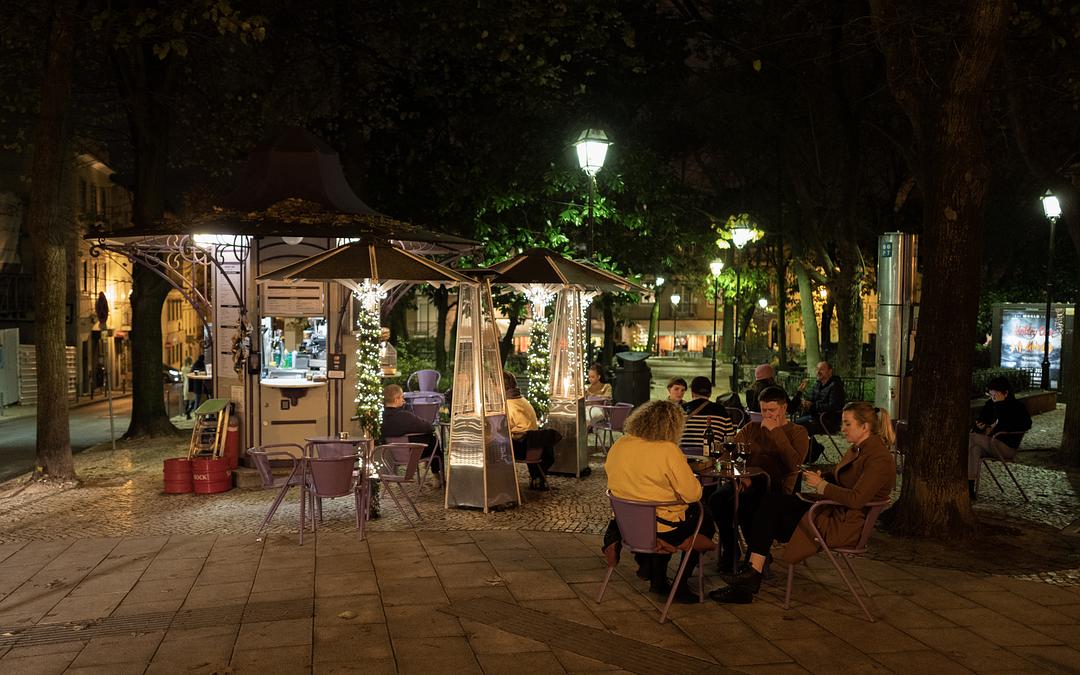
And the Soul Replenishment Station
Some alone, some in groups of two or three, order a glass of wine and sit around a corner of the garden. Accompanied by the colorful darkness, they talk freely, and life thus becomes incredibly mellow and rich.