Understanding and Enjoyment
Let’s talk about Bauhaus.
If you search for the German word “Bauhaus,” the results will likely point you to the nearest hardware store. The word is a very dry combination of “Bau” (building) and “Haus” (house). Is it a good word? From a purely artistic perspective, perhaps not. We associate it more with construction markets than with a comprehensive design philosophy. However, if we lower our perspective and look from a more general angle, we get a sense of something practical, functional, and closer to everyday life.
I think it is a good word. It has successfully and thoroughly fulfilled its mission. It has infiltrated our modern lives. It has turned into an invisible conceptual air. It is absorbed and understood. It surrounds us silently.
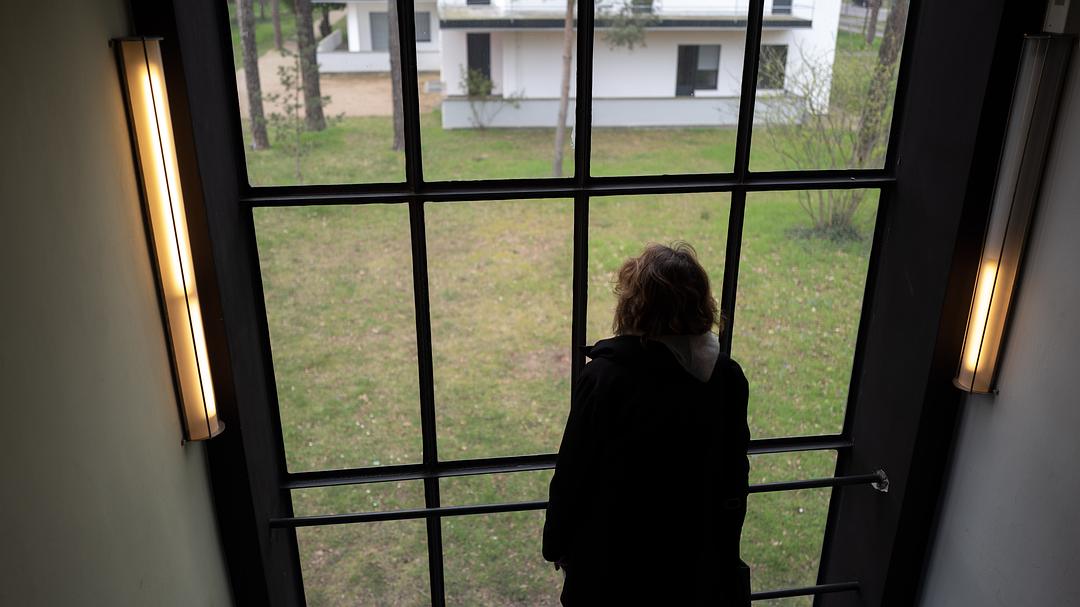
We should have a natural and intuitive understanding of Bauhaus. After all, we already have experience with it. Because it is so natural, it feels like watching a movie with spoilers. Long before I set off, I could already roughly outline the shape of this journey.
Of course, I won’t be discouraged by this. Based on personal experience, I suddenly realized that the triggering of emotions and feelings sometimes requires a rational foundation. A simple example is fingerstyle guitar. Through crisp rhythms and gentle or flashy tunes, people can feel the deep emotions conveyed by the player on stage. But actually, if you ask these players what they are thinking at that moment, the answer will definitely not be the joy of love or the sadness of heartbreak. Instead, they are thinking about the dynamics of the measure. They are thinking about specific transitions and preparations. It is a series of very serious technical details. We might feel disappointed knowing the truth. Yet, cold knowledge is indeed the prerequisite for a series of emotions.
Returning to travel, if one sets out with an overly innocent mindset, there is a certain probability of just wandering around in the realm of pure sight and sound. It does not emphasize direct shock to the five senses. That might have shocked people a hundred years ago, but modern people are almost numb to it. Instead, it needs knowledge as a catalyst to slowly stimulate the feelings.
Therefore, I had to read more articles and watch related documentaries before the trip. The goal was to understand its position in the historical timeline. This allows me to truly grasp how profoundly it has influenced our lives. Only in this way, when we are physically there, will those accustomed designs and structures jump out and shine. They activate the nerves in the brain. This allows us to obtain profound and unparalleled pleasure in the spiritual realm.
A Dry Introduction
Bauhaus was born in Weimar. It was originally a design school. It advocated the combination of art and craftsmanship. This was a very novel concept at the time. Later, due to political issues and other problems, it moved to Dessau. Finally, it was forced to close under pressure from the Nazis. It existed from 1919 to 1933. Although its life was short, its influence was extremely strong precisely because it was suppressed by negative forces. It eventually spread widely throughout the world.
Departing from Munich, you arrive at Lutherstadt Wittenberg station. Then transfer to the RB train to reach Dessau Central Station. It is not on the main high-speed rail line. Also, the area is sparsely populated. Therefore, driving there would be a better choice.
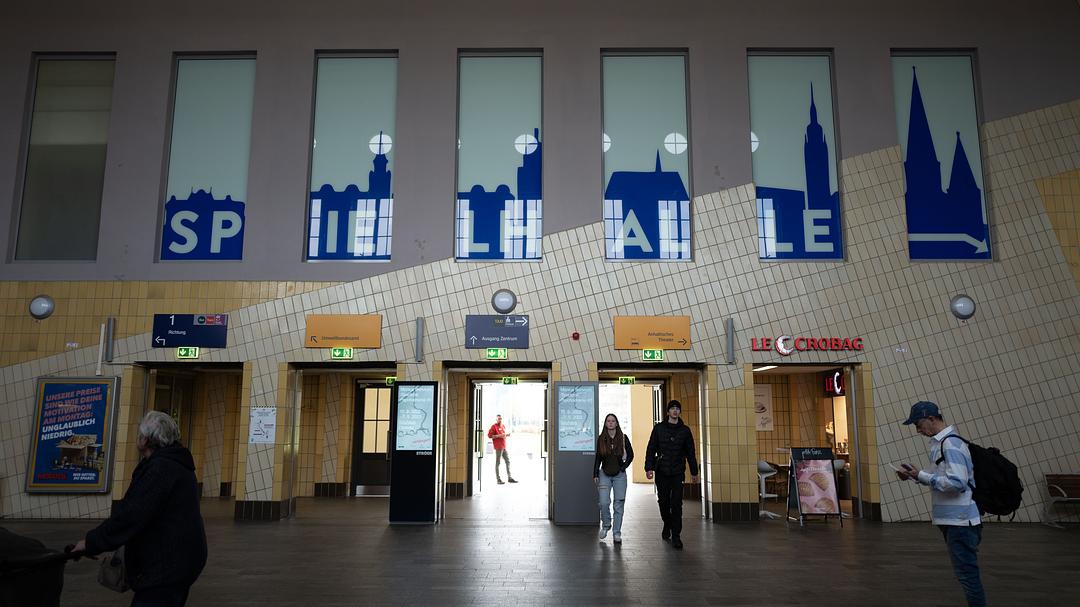
The main train station is very pocket-sized. Its underground passage splits into two directions. One leads to the city center. The other leads to the Bauhaus building.
On the way to the destination, you will pass the Hochschule Anhalt (Anhalt University of Applied Sciences) campus. This school is an applied technology school. Although it focuses on engineering, it still includes design majors. This part is responsible for Bauhaus. It can be considered a continuation of the academic tradition from back then.
The Bauhaus building does not refer to just this one building. It includes the school building and the nearby “Masters’ Houses” (model houses rented by professors).
Walking towards the city center, you can find the boxy Bauhaus Museum. To commemorate the 100th anniversary of the founding of Bauhaus, it opened in 2019.
Bauhausgebäude Dessau
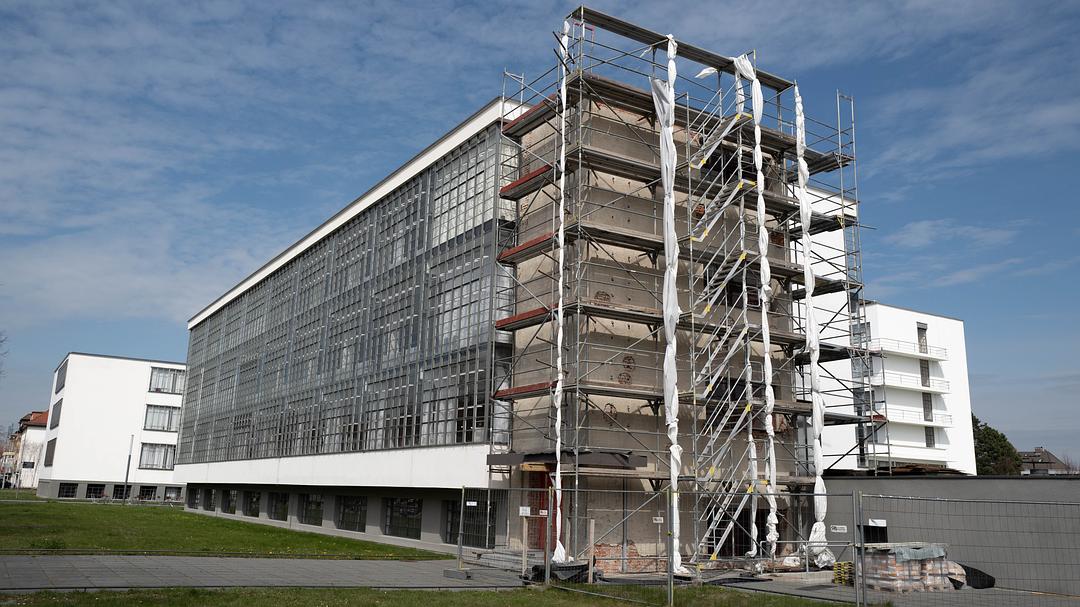
I don’t know how to call this school building in Chinese. If I translate it directly as “Bauhaus Building in Dessau,” it sounds plain. It has no special flavor. But on second thought, perhaps having no flavor is also “a kind of flavor.”
The facade is constructed of black, white, and gray. The overlapping square geometries sleep quietly there. An asphalt road divides it in two. A suspended corridor connects the middle. The main door is bright red. It is out of place with the cold outer walls. It sits coldly on one side of the road. On the upper right corner of the main door eaves, the word “Bauhaus” tells us that this is the Bauhaus building.
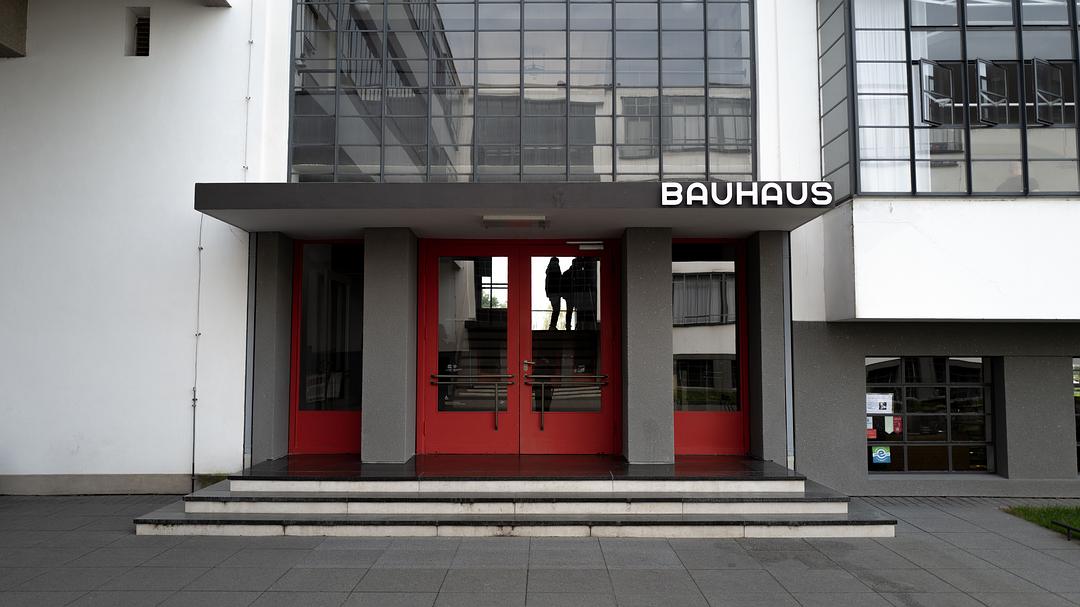
It evoked many of my impressions of architecture.
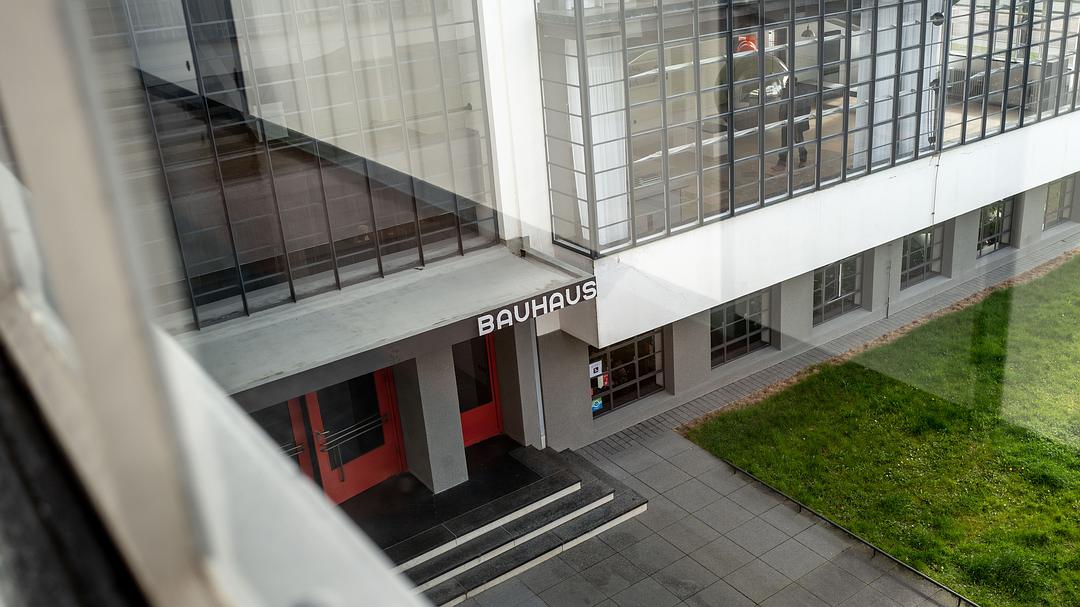
For example, the fact that it is bisected by a road reminded me of the building where I did my master’s degree at the Technical University of Munich. Every time we went to class or the cafeteria, we had to cross a road. Although there wasn’t much traffic, the intermittent stops were very annoying. The double-push main entrance, with stairs going up in the middle and down on the sides, is the school building from my high school memories. The large sheets of transparent glass are the scenery I see when I look up while doing homework in a coffee shop. Even now, I still like similar elements.
My current experience feels so natural. Yet the source of this experience comes from over a hundred years ago. Whenever I think of this, I feel a sense of awe. It embodies the foundation and abstraction of my architectural experience. Such an embodiment is also a concrete manifestation of how idea genes can be effectively inherited and disseminated.
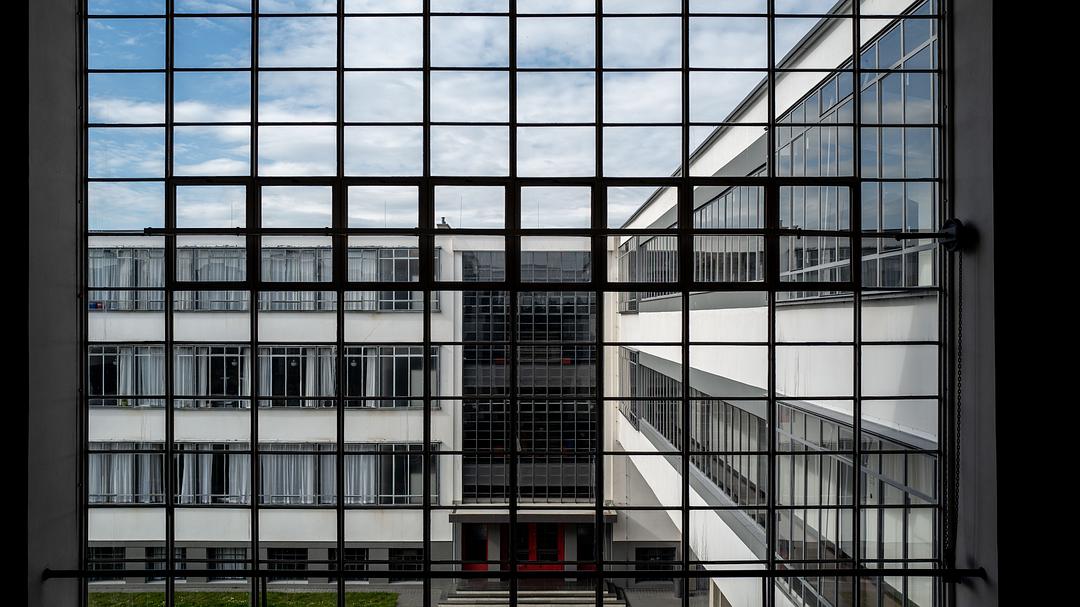
If I were to use one word to describe this experience, I think it would be “familiarity.” Unlike being immersed in life, it has more power and aggression. It actively moves forward to relate to our modern lives.
Its powerful force is not shown through religious-style grandeur. Instead, it surrounds life like a stubborn mist. Its manifestation lies not in our noticing it, but in our ignoring it. It is like looking up and thinking it is the sky. But we never realize it is actually just a wall.
This force does not make us wither or feel fear. On the contrary, it makes us develop a considerable dependence. I like to use details of life as examples. It is similar to the order of drying your body after a shower. Usually, this order is fixed. You trust this order very much. You believe this method will dry your body perfectly. It is never really noticed. But we trust and apply it. The order of this building brings me a sense of familiarity and stability. I don’t need to check a manual. I don’t need to probe carefully. From the moment I push open that red door, my experience of the building itself is already known by heart.
Similar phenomena are actually more common in philosophy and thought. We think we have original thoughts. Actually, most of them were mentioned hundreds or thousands of years ago. Through communication with parents, teachers, and friends, and through independent reading and learning, we gain insight into the genetic memory of thought. This power is the air we rely on for survival.
As mentioned at the beginning of the article, the implantation of spirit and experience is not easily detected. It can only be discovered through prior rational learning and thinking. Once detected, this power inevitably brings special enlightenment and spiritual tremors.
Sleeping with a Century
This building contains basic modules that prioritize function. The masters constructed the entire school building through orderly combinations. The advantage of this organization is clear. Even after a hundred years, although the function of the school building has disappeared, activating different modules can create buildings rich in other functions.
The original shop was changed into a souvenir shop and front desk. The cafeteria was converted into a bar and restaurant. As for the original studios, they naturally became exhibition areas for works. The student dormitories were converted into a hotel. A historical building that combines art tourism with accommodation and dining has thus regained its brilliance in modern times through recombination.
Check-in time is 2:00 PM.
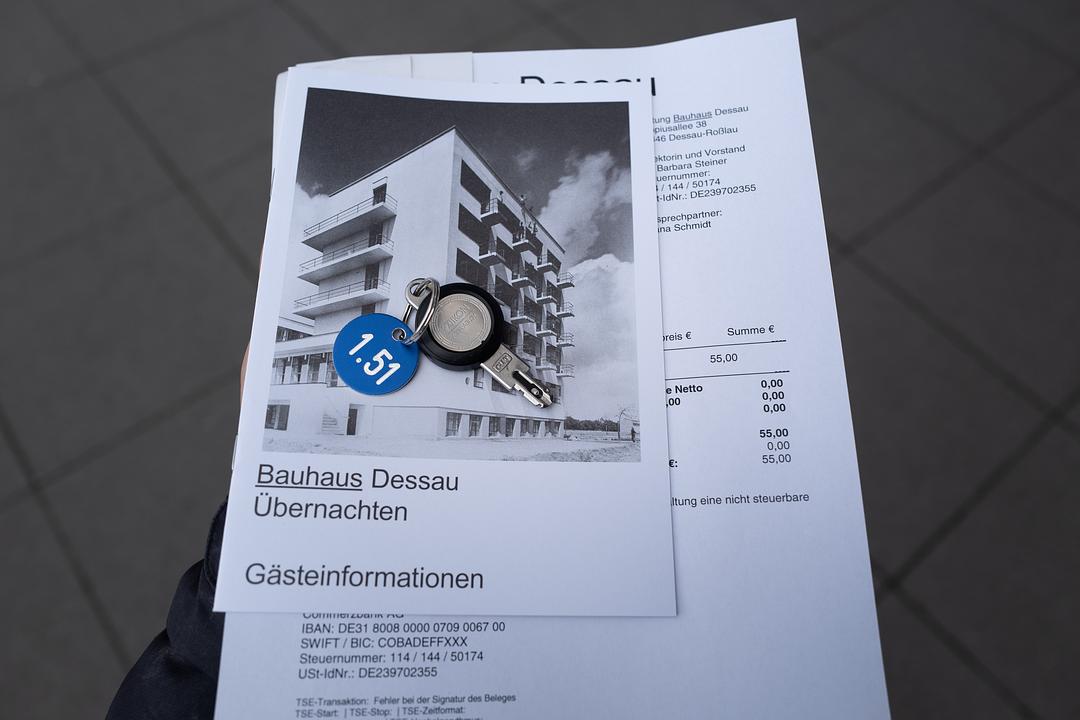
At the front desk, I received a small booklet. The introduction inside proudly stated, “Staying here is a very special experience, incomparable to an overnight stay in a regular hotel.” Walking out from the main entrance to the side wing of the building, you can see a small entrance.
According to the official description, this student dormitory was very luxurious at the time. One floor has about 6 single rooms. There is a shared kitchen, a bathroom, and a toilet. Because there was a cafeteria, the kitchen located at the far end is not large. To adapt to the water pipe system of the entire building, the shower part in the bathroom was raised. This formed an interesting “room within a room.” The separation of wet and dry areas is done very reasonably. It is worth referencing for future home decoration. The toilet part is simpler. Through the exposed water pipes, you can intuitively see that the sewage from each floor converges through this vertical pipe and flows out.
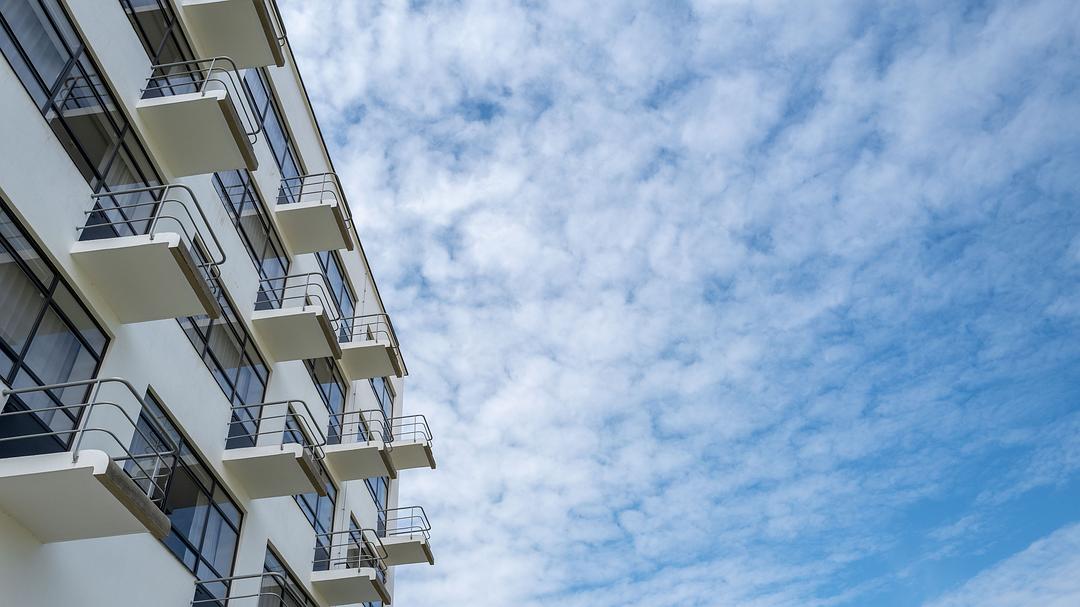
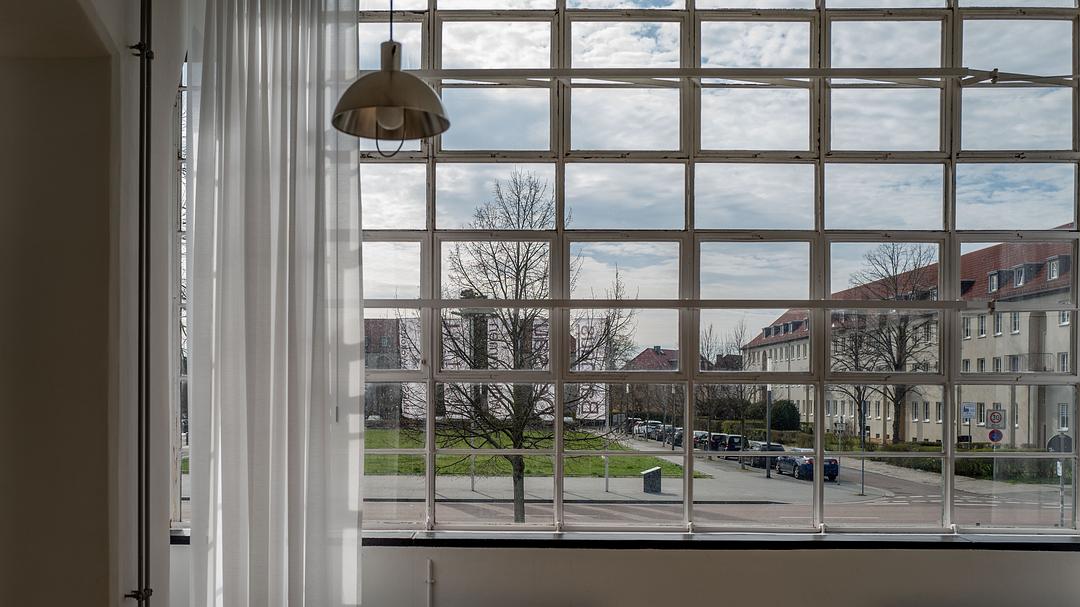
The single room is not small. It is very square. It has a sink, a classic red cabinet and desk, two chairs, a large bed, and two lamps. Facing outward is a huge rectangular window. On the left is a door leading to the outer balcony. The balcony is very small. It also has a square shape. To facilitate drainage, the shape of the floor extending out curls downward. It makes one feel unsteady. Of course, for people a hundred years ago, this mini balcony was a platform for explosive inspiration. Through black and white photos from that time, we can see young students crowding together for parties, creation, and photography. They did not care about the danger at all.
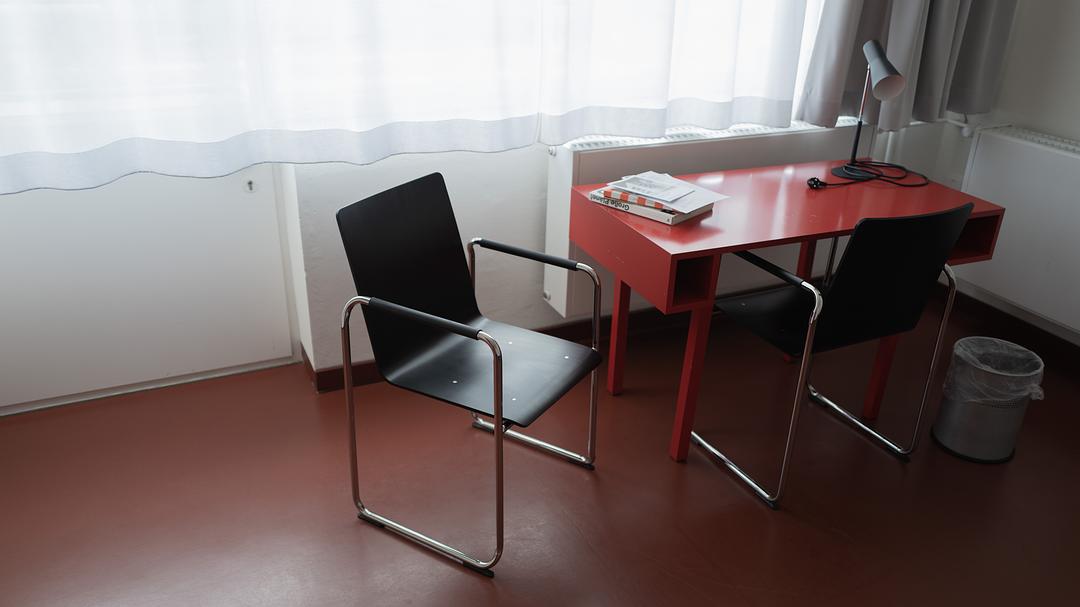
I searched my memories. What kind of accommodation atmosphere is similar to this? Piecing things together, it feels like a guesthouse from around the year 2000. Although the space is much more spacious, some of the furnishings inside are angular. They have a unique style and design sense. Yet I cannot say exactly why.
Of course, the above comparison is just a forced match. When it comes to specific details, there is a very large gap. For example, that red double-door wardrobe. The doors are very thick. Inside there are storage cabinets. After opening 180 degrees, it can be combined with the middle wardrobe to form a new combination cabinet. It is very clever. This kind of furniture design and attention to detail is definitely not found in ordinary hotels. In terms of overall feeling, saying it is like a guesthouse is actually trying to express its practical-first approach. For instance, the floor is flat and smooth. Walking on it does not make the noise of old wooden boards. The transitions at the wall edges and corners are simple and regular. You never get tired of looking at them.
Still, thinking about these designs, although they might show slight traces of the era now, makes one sigh sincerely. Considering this is a design from a hundred years ago, one wonders what kind of thinking and inspiration created such advanced creations.
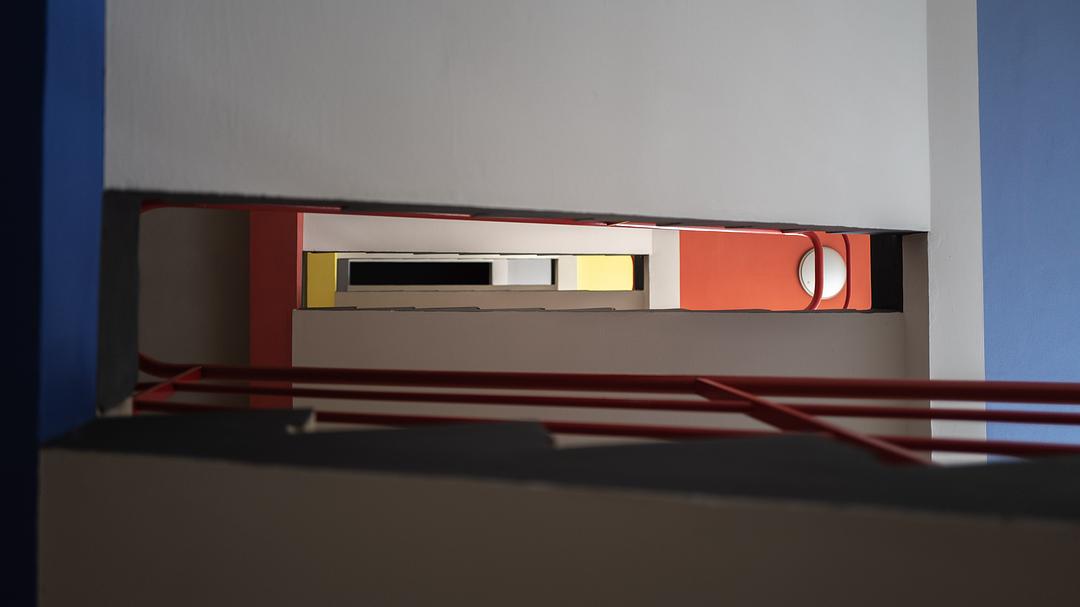
The space of the dormitory building is like a “lite” version of the Masters’ Houses. The capacity is smaller. But the design thoughts behind it have been retained. The railings in the corridor are bright red. The ceiling uses other different colors depending on the floor. Looking from a unique angle, it looks like a work created by a student of Mondrian. The slightly chaotic structure is full of youthful vitality.
Roaming through it, I imagine how students back then lived, studied, and created here.
In their spare time, everyone would crowd into a classmate’s small room. Those lucky enough to find a seat would sit or lie down. Those with average luck would sit on the floor or just stand. Everyone would gather in a circle. They would listen to a classmate with ideas emotionally recount their wonderful experiences of battling wits with professors. Or they would explain some brand new concept and idea. When the sun angle was right, warm sunlight would shine into the room. The classmate near the window would open the door to the balcony. Everyone would pour onto the narrow balcony. From up high, they would greedily enjoy the passion and vitality of spring.
Perhaps the room I am staying in is where a certain master once lived.